Tuesday, June 25, 2013

June 25, 2013

To be honest, I don't know what's sadder: the knowledge that artifacts representing the pride and enthusiasm of a generation are (currently?) buried underneath this building that has barely made it fifty, let alone one hundred, years, or that bank president Warren R. Bentley was so naive to believe that his building's fate would be any different than that of the fifty-year old Warner/Post-Standard building which had been razed a mere decade earlier. —blog entry posted June 27, 2008

Or saddest yet: the decision of the Onondaga Historical Association to open the recovered time capsule on a Thursday afternoon six weeks ago, with little publicity or fanfare; an opportunity for a centerpiece celebration for a rising downtown to go up in as much dust as 321 South Warren itself.

The apparent audience at the time capsule opening, screen shot from YNN News report

History is littered with footnotes, and that I should become one in this story—with no contact from the OHA in regards to the capsule's opening, despite acknowledging that they knew nothing of the capsule until I discovered its existence on the second-ever entry on this blog (five years ago this week)— is slightly insulting, but not inconceivable.  (In fact, I only learned of the opening last week, after reading this piece about time capsules.) That the entire Syracuse community became footnotes, at the very hands of the association whose mission is to "educate and encourage the exploration, appreciation, and utilization of the past in order to add value throughout our community," is inexcusable. 

I would have never known about the time capsule had it not been for the extensive coverage of its burial in 1950, but the same cannot be said for its opening. Searches of syracuse.com, wsyr.com, cnycentral.com all come up empty, though it is unclear if reporters were not invited, no shows, or did not did not archive the coverage on their websites. (The Syracuse New Times does have a small clipping, albeit with a misspelled "histrory".)  How can this be, when not only did the site of 321 South Warren Street once house both the Syracuse Herald and Post-Standard, but the documented capsule contents included a recorded commentary by E.R. Vadeboncoeur of WSYR, and copies of the all (when an actual multiple quantity existed) of the city's newspapers at the time?

The decision to put the Marcellus Observer in the tube was prompted by the suggestion that copies of every weekly newspaper published in Onondaga County during the week of January 15 be included among the capsule's contents. In addition, issues of the two Syracuse daily newspapers will be buried with the time capsule. (Marcellus Observer, January 20, 1950).

Contrast this with the coverage of opening of a century-old time capsule in Oklahoma this past April, with news reports from several local print and television outlets, video on Yahoo! News, and images of the entire capsule inventory on the Oklahoma Historical Society Facebook page. The OHA Facebook page contains only two photos from the capsule (and no live stream or tweeting of the event), with one generating this fitting comment and response:

—Cool! When was this opened?
—This was opened at 2:00 as part of our History House Party.
When the event, of course, was already history.


As the capsule opening was part of larger open house celebration—complete with a $15 ticket charge, which seems absolutely antithetical to the spirit of time capsules (even for one buried in a bank)—there apparently was no chance of any schoolchildren participating in a field trip at the museum that day, as there were on the afternoon my dad stopped by back in May 2009, to take some photos of the just-found capsule:


While I should have been excited to see photos of the capsule, I was far more taken with the kids in the background.  These teens appear to have expressions of actual interest on their faces! About history! Probably because in they have grown up in a world with very little mystery left, but this copper capsule, with its dented exterior and faded print, was a real-life buried treasure.  How can OHA Executive Director Gregg Tripoli speak of "creating a community identity and optimism and hope for the future" when the very hope for the future—young people—are nowhere to be seen as the capsule contents were revealed?

However, given that one of the later activities on the same day of the capsule opening was the opening of the Jean Daugherty Memorial Magic Toy Shop Room, the OHA clearly recognizes that nostalgia forms a large part of Syracuse's identity. Every article or column remembering the city of yesteryear posted on syracuse.com generates dozens—if not thousands—of responses and recollections. As Sean Kirst commented recently to a reader who remarked on the ongoing popularity of these nostalgia pieces: "I need to find some way to give readers the chance to do this [nostalgia remembrances] more routinely." Such as the opening of a time capsule, containing items from 1950 downtown Syracuse?


Syracuse Herald-Journal, January 21, 1950

Granted, there was no mystery as to the contents of this capsule; the citizens of 1950 apparently did not envision that the various newspapers and periodicals placed in the time capsule would be digitized, not only removing element of surprise, but the necessity for the capsule itself, as many of the items in this capsule can be found online. Or maybe they did, as the magic of a time capsule isn't about the artifacts, but the aura: the idea that a crowd gathered in downtown Syracuse sixty-three years ago, in hopes that one day, a similar crowd would come together and remember:
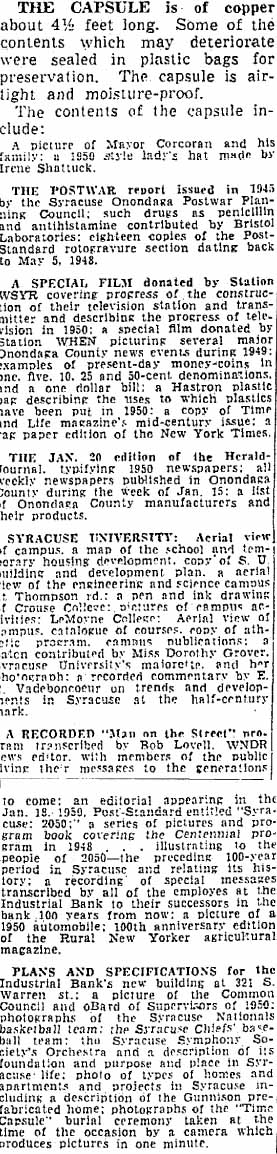
A hundred years from today this time capsule, as it has been termed, will be opened and probably the Syracusans of 2050 will smile a bit at this city's status of a century before. Probably they will wonder at the comparatively primitive fashion of our lives in 1950 and think we were rather odd folks. (Syracuse Herald-Journal, January 21, 1950)

No, when it comes to primitive and rather odd folks, 2013 seems to have 1950 beat. Given the unique opportunity to stage an event that could have highlighted downtown Syracuse both past and present, gathering the younger generations who believe in Syracuse with the older who have never forgotten Syracuse, the OHA instead chose to open the capsule in a near-empty room in the middle of the work/school day, when the very community that the museum is there to serve could in no way partake in the activity. I can only ask the question that has so often been at the heart of the sixty articles I have posted on this blog over the past five years:

Why?

Tuesday, January 15, 2013

January 2013

Architecture critic Ada Louise Huxtable, who died last week at the age of 91, started her writing career at the New York Times in 1963, and one year later, wrote an essay that singled out Syracuse as an example for all that was wrong about urban renewal. While I quoted a small excerpt of “Ugly Cities and How They Grow” in an entry this past November, I first read the piece shortly after I started this blog five years ago. I felt then—as now—that Ms. Huxtable’s piece captures Syracuse’s urban renewal with such prescient precision that not only should it be read in its entirety*, but, frankly, makes this whole blog “obsolescent,” as she summarized it all in about a dozen paragraphs of Pulitzer Prize-winning prose forty-five years earlier.

But what never gets old is the Syracuse response. John R. Searles, Jr., the executive vice-president of the Metropolitan Development Association, immediately penned a response to Huxtable and the New York Times (as printed in the Post-Standard, March 28, 1964). Rather than expressing anger or indignation at his city being called out as “ugly” in the nation’s premier newspaper, Searles essentially threw up his hands and agreed, the consequences of which Syracuse has been fighting back from ever since.

A breakdown of Mr. Searles’ letter (all emphases mine):


To The Editor of the New York Times:

Ada Louise Huxtable’s article in the Sunday Times, March 15, 1964, properly attacks the current ugliness of American cities, but does not mention efforts to probe the cause and find cures for the disease. In this she may give comfort to hand wringers and finger pointers who plead for historic preservation but hurt positive action programs which can actually preserve architectural assets and ally them “with the best new building.”


The “sick city” metaphor had been spreading through architecture and city planning circles since prior to World War II, comparing “blight” to decay and illness, and “open air” to cures. To be certain, the amount of sunlight necessary to disinfect the city wouldn’t be achieved by knocking down a few buildings in favor of pocket plazas; rather, massive amounts of land would have to be reclaimed. By the mid-1960s, architectural critics such as Huxtable and Jane Jacobs argued precisely the opposite:

To say that cities need high dwelling densities and high net ground coverages, as I am saying they do, is conventionally regarded as lower than taking sides with the man-eating shark. But things have changed since the days when Ebenezer Howard looked at the slums of London and concluded that to save the people, city life must be abandoned. Advances in fields less moribund than city planning and housing reform, fields such as medicine, sanitation and epidemiology, nutrition and labor legislation, have profoundly revolutionized dangerous and degrading conditions that were once inseparable from high-density city life (The Death and Life of Great American Cities, p. 218).

But Syracuse has often found itself stuck in a time warp, which is possibly why fifteen years after the James Street mansions initially met the wrecking ball and almost a quarter-century since the last streetcar ran in the city, Searles chalked up the ugliness to a byproduct of progress:

Most cities, like Syracuse, are making the traumatic adjustment from the street car to the automobile; from the pretentious mansion to the apartment and ranch house and from an economically dominant downtown core to a collection of shopping and commercial centers dispersed through an urbanized area. Syracuse in the last generation has also had to accommodate itself to the transformation of the New York Central right-of-way and the Erie Canal (both cutting through the center of town) into traffic arteries.

To meet these changes of the last 30 years, cities had no clear plans
—and if they had plans—they had no legal powers to give effect to plans which might direct new construction and destruction towards more aesthetically pleasing results.


Of course, this didn’t stop Searles from arranging a two-and-a-half week tour of European countries for himself, Mayor Walsh, and seventeen other city notables (and their wives) for “city planning” services six months earlier!

The increase in automobile traffic and the loss of pedestrian traffic has had such a devastating effect on downtown property values that cities relying heavily for financial support on ad valorem real estate taxes have been understandably obsessed with the economic rather than the aesthetic effects of urban change.

How many cities can expect a Williamsburg treatment or have the opportunity to enjoy a Georgetown rehabilitation movement? Owners of obsolescent but historic property cannot be expected to let sentiment outweigh economic considerations for any substantial period of time. Children sell the family mansion when the land becomes more valuable as an apartment or office site than it could possibly be worth with the old house
—heavily taxed and expensive to maintain—undemolished.

Interestingly enough, while we have come to associate urban renewal with the destruction of the historic 15th Ward, Searles seems clearly focused on the James Street transformation. Hardly surprising given that Searles and Mayor Walsh decided to tour Europe when hundreds were picketing City Hall in support of the residents of the 15th Ward, but a bit of a head-scratcher when you consider this: there was little to no organized public support for the historic preservation of the James Street mansions:

If the 2000 persons who roamed through the old Gen. Elias W. Leavenworth mansion at 607 James Street could have displayed the same interest a few months back as they did yesterday, then the remains of one of the last of Syracuse's historical landmarks yesterday might not have been picked over, inspected closely, fondled gingerly by those prideful of their city's past or disdained by a handful seeking just practical usage of the old items. (Post-Standard, May 16, 1950)

Also puzzling is Searles’ reference to Georgetown, as their residents were successful in saving endangered historic architecture by precisely focusing on the economic value of the buildings:

Historic Georgetown, Inc., in Washington, D.C. successfully bought and rehabilitated several outstanding examples of mid-eighteenth century architecture at 30th and M Streets in that city. In 1951, the houses were about to be torn down to build a parking lot. To save these buildings, a group of Georgetown residents formed Historic Georgetown, Inc. The aim of the corporation was to make not only a sound architectural restoration but also a sound business achievement. Money was raised by the sale of stock to Georgetown residents and a plan was worked out whereby subscribers might donate their stock to the National Trust and take a tax deduction for this gift at par value. As a result, the National Trust is now the largest single stockholder in the corporation. The restoration of these buildings is now complete except for one small apartment. The completed part is fully occupied on long-term leases and the rentals provide a sizeable surplus above upkeep, taxes, interest and preferred dividends. The operations of the corporation are deemed locally to be quite successful (College Hill: A Demonstration Study of Historic Area Renewal, Providence City Plan Commission, 1967, p. 13).

Yet Searles was very familiar with the area, as prior to his position as chief executive of the Metropolitan Development Association, Searles had worked as executive director of the Redevelopment Land Agency in Washington, D.C. for from 1951-1961, where he oversaw the “redevelopment” of Southwest Washington:

Inspired by the resurgent downtowns he had seen emerging from European cities damaged in World War II, Mr. Searles sought to bring a similar spirit of modernism to Washington...From 1954 to 1960, the old rowhouses and alleyways of Southwest were demolished, along with hundreds of small businesses. About 20,000 residents, most of them African American, were forced to find new homes.

The best current solution and indeed perhaps the only solution of general availability is urban renewal. The acquisition of obsolete blighted property and resale subject to conditions of preservation and architectural standards is making possible the retention of many fine old buildings. The use of renewal to study and preserve structures in the College Hill area in Providence is an outstanding example.

Searles is referring to the 1959 study conducted by the Providence City Plan Commission  which proposed the use of federal Urban Renewal funds not to raze the historic buildings of College Hill but—gasp!—restore and renew.

A number of architecturally significant structures in Southwest Washington which were surrounded by slums and inadequately maintained are being brought back to life through urban renewal. Wheat Row, built by Lawrence Washington, George's brother, the Washington, Lee and Barney Houses are being integrated in Architect Clothiel Woodward Smith's design for the Harbour Square apartments.. The Law House to the north of N Street S.W. was required to be preserved in the Tiber Island Development. Both preservations were accomplished through urban renewal.

The best opportunity for Syracusans to save the Third Onondaga Court House is through urban renewal. There is no current apparent economic use and developers seeking the building as a parking lot gain support with offers of taxes for currently public property. They are held off only by a group led by Common Council Majority Leader Albert Orenstein, who has a considerable following in his efforts to solve a very difficult problem. Local citizen efforts saved the Weighlock Building on the old Erie Canal. The Syracuse Savings Bank has made an "uneconomic" investment in the' preservation of its local building.


The difference between Providence’s College Hill plan and Searles’ self-congratulatory Washington references—and stated plans for Syracuse—is that Providence aimed to preserve not a mere building or two, but the entire neighborhood:

Unfortunately, the approach in most cities has been piecemeal, and except in a few instances, only one or two of the techniques described in this report are in operation at any one time in a locality. The comprehensive approach to renewal of a historic area is needed and the techniques described in this report may guide the way for such renewal in College Hill and in other parts of the country. (College Hill: A Demonstration Study of Historic Area Renewal, Providence City Plan Commission, 1967, p.13)
(Granted, it should probably be noted that a mere two years after publishing this report, the Providence City Plan Commission published an urban renewal plan for Downtown Providence not much different than Syracuse’s own, yet never materialized due to lack of interest.)

A total downtown urban renewal plan now underway has among its objectives one of saving the best of the old architecture not only for sentiment or to blend, but also to influence and to guide the design of new buildings. Syracuse would be vain to aspire to become a Paris or Vienna, but it is proud and becoming increasingly sensitive about its appearance.


Syracuse could never aspire to be a Paris or Vienna, yet Searles organized three additional trips to Europe after the initial 1963 excursion for himself and the city VIPs, in the continued name of city planning!

Similarly, from Searles’ 2005 Washington Post obituary:

Writing in The Post, Mr. Searles extolled the parks of Copenhagen and the vibrant urban dynamism of Rotterdam, but that rosy vision of Southwest Washington never developed. Instead, it remained largely desolate until highways, large office buildings and apartment houses were built in the 1960s and 1970s.
We agree with Miss Huxtable’s estimate of the significance of the Council on the Arts’ excellent study, but disagree strongly that "most urban renewal seems doomed to sterility.” Rather, cities which like Syracuse, wish to use their excellent old buildings as the cornerstones of reconstruction, will find urban renewal to be their best and perhaps only solution.

JOHN R. SEARLES JR.,
Executive Vice President.
Metropolitan Development Association
of Syracuse and Onondaga County


Just a few of the “excellent old buildings” that didn’t make the “best of the old architecture” cut:

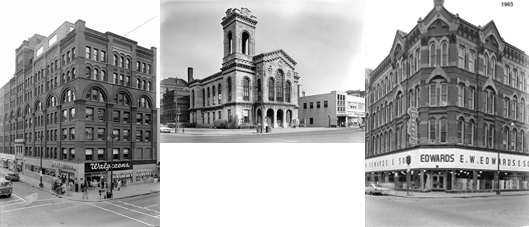
From left: McCarthy Warehouse, Third Onondaga County Courthouse, Kirk Fireproof Building 

And their replacements:


***

[Ada Louise Huxtable] liked Boston’s City Hall when it opened in 1968, although most people didn’t, and she liked it 40 years later, when a young generation of architects was coming around to its Brutalism, but much of the public still wanted to tear it down. The building was “uncompromising,” she wrote. 

Like her. ( New York Times, January 8, 2013)

Which brings us to the greatest flaw in Syracuse urban renewal plans: while the results were certainly uncompromising, the decisions—and decision-makers—were capricious if not downright capitulating.  Although little protest was raised over the loss of the James Street mansions, newspaper editorial writers nevertheless predicted an “ugly city” essay in Syracuse’s future:

Syracuse has too little that is old and good, so it has suffered a defeat that will hurt it for years in the loss of the great Leavenworth mansion...
Soon it will be a memory and Syracuse will have left only the old and hideous, none of the old and beautiful and no proof, but rather the opposite of it, that it has any respect or reverence for what our fathers accomplished. If we do not cherish and keep our best examples of beauty, we are soon surrounded by the drab and ugly and our lives reflect the environment we have elected. (Post-Standard, July 15, 1950)

The 1965 Downtown Urban Renewal Plan justly saw its revitalization potential in providing unique opportunities not available in the outlying neighborhoods:

Central Syracuse should seek out and encourage those few-of-a-kind supporting activities which, by virtue of their location in or near the central area, contribute to its "optimum" location.
and then tore down an entire city block for a new department store, even as the ones that had anchored downtown for decades were closing and moving to the suburban shopping malls.

And perhaps the most egregious compromise:

The mayor is certain that he will be able to stop any thinking along the lines of elevated highways. He said that state officials agreed to “review the situation.” Mayor Henninger added he has learned that such elevated highways “have ruined other cities.” The mayor also pointed out that he and his administration would “have to move fast. We are on top of this and will keep after it.” (Post-Standard, April 13, 1958)


Syracuse Mayor Anthony A. Henninger indicated the city will not hold out for a depressed-type construction. He is more interested in getting the highway built than quibbling over whether it will be built above or below ground level, he indicated. (Post-Standard, February 25, 1960)

These days, there seems to be the general air that renewal—for real—has arrived downtown, as the old cornerstone buildings that survived are being renovated into high-end condos. Yet while their original beauty is restored, a new ugliness is creeping in:


“It’ll be a different corner,” said David Nutting, the chairman and CEO of VIP Structures, whose bid for a $25 million redevelopment of four buildings across from the Dunkin’ Donuts stipulated the long-planned bus move must happen for the Pike Block project to go forward.

Would Nutting have taken on the project – with its 78 apartments, 25,000-square-feet of retail space and new walkway to the more bustling Armory Square – if the buses and riders had stayed?

“I don’t think so,” he said.

For as Huxtable wrote, architecture is about far more than aesthetics or silhouettes against the skyline. From her New York Times obituary:

Though knowledgeable about architectural styles, Ms. Huxtable often seemed more interested in social substance. She invited readers to consider a building not as an assembly of pilasters and entablatures but as a public statement whose form and placement had real consequences for its neighbors as well as its occupants.

“I wish people would stop asking me what my favorite buildings are,” Ms. Huxtable wrote in The Times in 1971, adding, “I do not think it really matters very much what my personal favorites are, except as they illuminate principles of design and execution useful and essential to the collective spirit that we call society.

“For irreplaceable examples of that spirit I will do real battle.”


*As posting the article in its entirety might run against Fair Use laws, if you wish to read it,  it can be found in  the March 15, 1964 edition of New York Times, or the March 28, 1964 edition of the Post-Standard.

Wednesday, December 26, 2012

December 2012

Syracuse Herald, June 5, 1923
In May, I returned home to run the Mountain Goat. Despite being one of the hilliest courses I’ve raced, I achieved a new personal record: the most miles ever covered in Syracuse without being chauffeured by my parents.

Though most of the landmarks of my childhood experience in Syracuse are long gone, one remains steadfast: the necessity of a car to travel anywhere in the city. The Mountain Goat provided a ten-mile traffic-free tour in about the same time it would take to walk from the Regional Transportation Center to Downtown Syracuse (if the pedestrian unfriendly route didn’t cause the ultimate DNF). A taxi ride would cost approximately $15, an expense equivalent to half the entry fee of the race. Ironically, one could walk to the start line of the Empire State Marathon from the bus station, but picking up the race packet would require a 9 mile trip to
—of all places—Driver’s Village. With no race-provided shuttle, taxi fare plus tip would be close to $40—the price of a Greyhound bus from New York to Syracuse. Walking would be its own medaled event.


While the city does not control logistics of race planning (they would just prefer not to have the runners on the streets), I use these examples to illustrate how two major happenings with the ability to draw a large number of out-of-towners effectively shut out any who arrive without their own means of transportation.  Does Syracuse require that every visitor either drive or rent a car? Or otherwise factor in expenses of taxis in an area that has been expanding outward since World War II?  Or use the bus system that the city (or, at least, its newspaper) considers is for "mostly poor and black bus riders"? View the “Getting Around” page on Syracuse Convention and Visitors Bureau website, and the visitor is presented with nothing more than a list of taxis, car rentals and a blank Google map:


While car-free visitors are left to their wits and a detailed “beer trail” map, the SCVB is busy counting license plates of out-of-town cars in the Carousel Center Destiny USA Carousel Center parking lot. Of course, if the route from the Transportation Center to the mall was made a bit more pedestrian friendly, there could be numerous shoppers arriving from practically any location in the United States or Canada in just a few steps. But why consider a pedestrian bridge that could lead out-of-town travelers from the train or bus when you can build one that takes them back to their cars?

The Regional Transportation Center recently expanded its parking lot to accommodate the increased number of Amtrak and Greyhound passengers:

The number of people who use the inter-city transportation services at the Transportation Center has grown significantly since we opened in 1998,” said Central New York Regional Transportation Center Executive Director Frank Kobliski.  “We have reached a point where we need to expand to accommodate our customers.”

Not only is it ironic that Syracuse acknowledged an increase in bus and train travel by adding more parking spots for cars, but the plan is completely one-sided.  If more people are leaving Syracuse by train and bus, wouldn’t it stand to reason that more are arriving by these same modes of travel? And if so, where are their accommodations? The only improvement geared towards pedestrians is the addition of “direct sidewalk access between the facility’s main entrance and a new sheltered taxi stand,” where presumably visitors can remain dry before their wallets get hosed. 

Former Greyhound terminal in downtown Syracuse.
Opened in 1941, razed in 1960s for construction of
MONY Plaza. 

Syracuse seems forever caught up in its car culture, extending its bias even towards the new Centro bus hub. Apparently, the $18.8 million, 38-years-in-the-making project was never meant to revitalize downtown by encouraging more mass transit use, but rather, be transformative by removing bus-riding pedestrians from the path of car-owning pedestrians. Why not utilize the hub as an additional stop for Greyhound and Megabus, allowing visitors to walk to a hotel or through the new-and-improved downtown? (Though one has to ask, if “downtown living” still requires a car, do any of the much-ballyhooed downtown condo dwellers truly “live downtown”?)


Shortly after my springtime visit, Syracuse went agog with the news that the Wegmans Pond Street location would close by month’s end, potentially leaving the area’s elderly and non-driving residents without a supermarket within walking distance:


Nicoletti said he doesn’t buy into Wegmans’ numbers and said the company is abandoning shoppers who rely on the store because they can walk there.
“It is an area in transition, an area we are fighting for, and the city is fighting for,” said Nicoletti. “They worry about a TV commercial with Alec Baldwin. They should worry about people who don’t have vehicles, who are handicapped.

If Syracuse’s chickens were going to come home to roost, then perhaps it is only fitting that they did so at a Wegmans. While this crisis seemed to be quieted by the later announcement of a Tops in the same location, where is the uproar for the senior suburb dwellers who in due time may have to give up their car keys? My parents don't have the option of walking to a supermarket or even a bus stop. Without a car, they will be as stranded at their house as I am without their ride when I come home to visit. A sobering reality from which I cannot run away.

Monday, November 12, 2012

November 2012

In cities like Syracuse, new and old co-exist as bellicose, resentful strangers. There is a curious, Martian mixture of almost surrealist strangeness; Queen Anne gingerbread next to cantilevered steel.

The old waits grotesquely for the new to swoop it to destruction, and the all-important lesson of urban design is still unlearned. You don’t wish the old city away; you work with its assets, allying them to the best new building for strengthening relationships to both.

At present, most urban renewal seems doomed to sterility. As long as its architects reject the past and fail to deal in continuity, what they produce will be a nightmare mix. Values will be lost instead of added. The Council’s architectural study [Architecture Worth Saving] is the first sign of the civilized maturity that can save cities like Syracuse from self-destruction.

—Ada Louise Huxtable, “Ugly Cities and How They Grow,” New York Times, March 15, 1964 (and reprinted in Post-Standard, March 28, 1964)


Alas, a siginificant number of buildings listed in the 1964 Architecture Worth Saving study have since met the wrecking ball, and the “nightmare mix” of the resulting landscape became the inspiration for this blog five years ago. I was never so much interested in the nostalgic remembrances of department stores and downtown days gone by but rather the reimaginings of what could have been: what if the historic mansions still lined James Street? What if the 15th Ward still remained, or if North Salina Street had not been cut off by elevated railroad-turned-highway? What if the theaters had not been torn down for parking garages, the hotels for parking lots? Though what I’ve never really explored is this:

What if the postwar vision for Syracuse had been fully realized?


Tuesday, January 31, 2012

January, 2012


To the editor of the Post-Standard:

In regards to the much talked-about war memorial, I would like to say, like all other projects in the city, I am afraid it is going to be too small. It may be alright for the city of today, but 20 years from today it will be like the U.S. Post Office built 20 years or more ago, too small.

Look around at some of our buildings in recent years, MacArthur Stadium, too small; post office, too small; NY Central Station, too small; State Tower Building, too small, and a lot of other projects which were big enough when built, but too small now. 

Now, 9,000 seats are too small for boxing. I saw a few boxing matches at the ball park last summer, and they say the ball park seats 12,000. Well, I had to sit on the concrete steps, because I could not get a seat. That would give you an idea just how many seats you would need if let’s say, DeJohn fought some top flight boxer like Tony Zale or Marcel Cerdan and others. Why, you have to turn them away.

While we are at it, let’s build it big enough, or let’s not build it at all....Syracuse is going to be a pretty big city in a few years to come, and a small coliseum is going to be just too bad.
…Anyway, in conclusion, I will say here’s for a bigger coliseum, one that you will not have to try to make larger later.

William J. Ganeau, Syracuse February 17, 1949


Post-Standard, April 23, 1976
What was that I wrote in my last entry about “back to school, back to work, back to activities and appointments that often seem to continue non-stop through year’s end”?

Yes, this blog has been on the quiet side, but Sean Kirst’s article about the musical history of the War Memorial inspired me to revisit the archives. To be honest, I haven’t been inside the War Memorial in over thirty years, and the closest I’ve come to a rock concert at the venue is a clown parade at the Shrine Circus. But as the article made clear, most War Memorial memories are well entrenched in the past, leading many commenters to debate the future of the facility:

johnsyracuse: Sorry guys....I am a veteran myself...but the War Memorial is a sh##hole. It's a building, like many before it and many after it whose designed function has gone the way of the dinosaur. Replacing it no way disrespects our veterans. In fact; I think it is more disrespectful NOT to replace it. That being said...who wants to pay for it? The state needs to focus on the infrastructures that benefit everyone for the right reasons; not rebuild a worn out building. Syracuse has not been a mecca for rock bands for a long time. I travel to Rochester and near Albany to hear anything relevent. Seems unnecessary to me.

Michelle Klukiewicz: totally disagree John....I think if the War Memorial is spruced up a bit, many of the bands today that I am sure are fans of the past bands that graced the stage at the WM, would be honored to play in the same place....I would LOVE to attend a show there...somethings are sacred and should be treated as such..it honors the Veterans as well as the music that in my opinion..keeps us all sane..." let the music keep our spirits high"....


The conflict is obvious: the War Memorial has a dated form tied to timeless function. Yet why had such a decision been made during a time when obsolescence was linked with progress?

“The pace of obsolescence is growing more rapid,” Mr. Grimm said. “We must make things more susceptible to obsolescence in order to make way for progress. If dresses were designed to so that women wore them until they fell apart, the dress industry would die. There will be more acceleration in change of design." (Post-Standard, February 26, 1955)

If city leaders envisioned a 21st century downtown Syracuse with "modern structures of glass and steel," then why did they decide upon the construction of an arena as a war memorial, which would certainly be a target for demolition as it aged? Is this another case of the post-WWII generation fulfilling an immediate need—much like the highways and suburbs—and leaving future generations to sort out the inevitable conflict of interest? Or were there Syracusans who foresaw these 2012 comments in their own impassioned letters over 60 years ago?


To the editor of the Post-Standard:

Will Syracuse ever get out of the one-horse town class?


Imagine a city the size of Syracuse thinking of building an auditorium that will only seat 8,800 maximum!


That is what you would look for in a village the size of Baldwinsville.


Don’t they ever expect to have any large conventions in Syracuse?


Maybe they are only planning on a peanut vendors’ convention.


It looks as if the major veteran organizations will never be able to hold another convention in Syracuse. What they have planned now is not suitable to veterans and the whole of Syracuse.


What a war service memorial!


Why not get smart and put up a memorial everyone will be proud of and not ashamed of.


Why not go two or three levels underground if they want a squatty building, and have the entire main floor for an auditorium only, with offices, meeting rooms, etc. on the floors above?


It might be well for some people to get out and visit other cities and see what is needed in such a building. Let’s not throw our money away on something that will be useless!


Member of VFW and American Legion
Marietta
March 12, 1948


Economy had been essential during the World War II years, so not surprisingly the War Service Memorial committee saw a multi-use memorial as a most ideal solution:

For some time prior to the appointment on January 10, 1945, of the original six members of the Onondaga County War Service Memorial Committee by [Onondaga County Board of Supervisors chairman] Mr. [Edward] Yackel and Thomas E. Kennedy, then mayor of Syracuse, there had developed considerable sentiment and need for a civic center. This sentiment and this need were promptly visualized by the committee as the ideal solution to the primary problem of what type of memorial should be adopted. 

We saw and grasped the opportunity to realize in one move two long-hoped-for ambitions...a fitting war memorial and a community center with unlimited possibilites for general public use. Having reached this decision we began planning for the time when the citizens of the city and the county would have their own civic center adequate for any social, cultural or athletic indoor activity, and simultaneously, a memorial to those who gave their lives, those who served in the armed forces and those who served on the home front. (from War Memorial Progress Report given by Hurlbut W. Smith, chairman of the Onondaga County War Service Memorial, Inc. to Onondaga County Board of Supervisors chairman Edward O.Yackel and Frank J. Costello, Syracuse mayor, on February 15, 1947, reprinted in Syracuse Herald-American, February 16, 1947)

Yet it quickly became clear to the parties involved that one building could not be all things to all people:


“A sports arena, and a music hall, and theater can never under any architectural plan be housed in the same hall. Love of theater, music, dance or beauty must not come in a poor second again when a civic enterprise is under consideration. Whatever the final decision, it should be representative of both athletic and cultural groups. Perhaps the amount should be increased so that the plans might include two complete and separate units under one roof. If it is impossible to raise such an amount, let’s do one or the other and create a memorial of which we we all may be proud for many years.—Dorothy Kelly Carr, Mary F. Lynch, Marydee Richards, directors of Children’s Theater group of the Museum of Fine Arts

“The civic center should be in two complete units, one as an auditorium to seat about 3500 in permanent designed seating, including all necesssary facilities for stage—the other an arena type for sporting events, conventions and the like. Each unit could then operate independently of the other. To us, the idea that one auditorium could be used for a hockey match one night and a symphony concert the next in the same hall seems highly impractical. It is up to the people to see that one center is built to satisfy the needs of the various civic enterprises, even if necessary to allot more money in bonds. It must be built right to serve many years.”—David B. Salmon of Dave Salmon, Inc.

(as quoted in Syracuse Herald-Journal, March 11, 1947)

A year earlier, the War Memorial commission had plans for such a “2-in-1” building, and retained L. Andrew Reinhard, an architect who worked on Rockefeller Center, to design a building with “two separate areas, one a music hall, one a sports arena,” and left the decision to Reinhard to “put both under one roof or erect them separately” (Post Standard, March 23, 1946) Yet as there was only a limited amount of land for the building, sports enthusiasts quickly saw the flaws in this proposal:


Here we go again on the proposed sports arena. The county memorial committee has revised its plans again, this time to evolve some method of satisfying both the sports fans and the so-called cultural group. I would like, at this time, to emphasize again that the plans better be good....

It is my personal opinion that the Putnam school site for the proposed memorial building or buildings isn’t big enough for two auditoriums, providing the sports arena, which would be part of the building, is to be big enough for profitable operation. …

Many fans want more than 7,500 seats for sports events , but any rate, that should be the minimum, and worthwhile promotions could not be attracted to Syracuse if the seating capacity were less. (“Keeping Posted with Bill Reddy,” Post-Standard, March 23, 1946)


To the editor of the Post-Standard:
Bill Reddy is right (Keeping Posted, March 23) and more power to him! The county war service memorial committee can’t please everyone, but if this is to be a war memorial, let’s have what the veterans want, a first class sports arena.

...If it is to be a war memorial and the money is to be raised by public subscription, let’s give the veterans what they want and not camouflage about it. The veterans want to be entertained, they don’t want to be “cultured.”

If those who want an auditorium for conventions and a music hall are in earnest, let them go out and raise money independently for it, and not try to ride in on the backs of the veterans.

There’s only one location in the city that would be big enough for a sports arena with an eye to the future when Syracuse will be much larger. That is the old New York Central railroad station property. Close up that one-block extension of West Washington Street and use the entire space and then a sports arena seating 12,000 to 15,000 could be erected.

Let’s either drop the whole thing or give the veterans what they want. Ask them, they’ll tell you quickly enough, you memorial committee members.
Peter Piper
Syracuse
(March 26, 1946)


Not only was lack of space a concern, but lack of budget as well. An initial shortage of building materials in the years immediately following the war led to higher costs, which led some to question whether a more substantial arena could be built if the project was held off for a few years:


While a large number of veterans are pressing for action, others are said to be taking the same view the board has taken thus far, that it would be unwise to undertake erection of the building under present conditions.

Because of the prohibitive cost of materials and labor and difficulties in procuring many items at any price, it is said if a decision to begin this year should be reached, it will not be possible to carry out the plans, for the sort of memorial building that has been proposed. There is fear that if a building of the sort that could be built is erected, regrets are likely to be heard a few years hence. (Post-Standard, January 28, 1948)


This point became further emphasized one year later, when none of the construction bids submitted to committee came within the 3.5 million dollars appropriated for the project:


Since the bids were opened, architects and engineers have been figuring substitutes and alternatives and otherwise wearing out their pencils in an effort to make $3,680,000, plus architects’ fees, plus extras not included in the contracts go into $3,500,000.…

How far the architects and engineers can go in recommending substitutions is another question. The memorial has been “sold” to the public on the basis of the plans and specifications on which bids were submitted, and to cheapen it to a point where the public might suspect that a “shoddy” memorial to the county’s war heroes would eventuate could result in trouble, a possible situation that board members are keeping in mind. (Post-Standard, July 24, 1949)


By the time construction began in late 1949, nearly every facet of the building had come under criticism. Ninety-two Syracuse University Architecture students signed a petition calling the auditorium’s design by Edgarton & Edgarton “a disgrace to any progressive city...with all of its superfluous ornament resembles a colossal wedding cake.” (Post-Standard, March 10, 1948).  Several Post-Standard editorials lamented the lack of dedicated theater space, and worried that Syracuse would always lose valuable performances to other upstate cities:


Recently many of  the city's music lovers went to Rochester for an opera performance with the famous tenor Tagliavini. Many more will go to Utica on the first of April for another opera with this famous tenor.

It is always away from the  city— never here that we can attend and enjoy events of this kind.


While Syracuse certainly is not as much of a musical city as Rochester, it seems pathetic, to say the least, that Utlca could get the drop on us and take its place as a Central New York gathering place  for the many people who like the opera and the legitimate stage.


The proposed sum to be spent on the county war memorial will do very well for a sports arena.  But we might as well forget about a theater thrown in to boot. It would take more than that for a suitable theater alone. By suitable we mean a permanent theater seating at least 3,000 in comfort, acoustic excellence  with a perfect view of the stage from every seat in the house, the very best in all stage  technical requirements, and a simple and dignified exterior. That names a few of the specifications in  general.
…


If people in this area are going to listen to opera and orchestral music, and maintain a love for the legitimate stage, they are going where those needs in their lives are available.  If they can't come here, they will go to them.

Is Syracuse going to admit defeat in this matter, or is it capable of taking the bull by the horns? (Post-Standard, March 23, 1948)


And the complaint as old as downtown and cars themselves, parking:


The question is, of course—where are those 8,000 or more persons going to park around the proposed sports arena, provided it is located on the site given out in the elaborate publicity.

Your paper editorially and otherwise, and committees concerned with parking facilities in Syracuse, have been asking the same question over and over again—where are people going to park?  (from a letter to the editor signed “Curious,” Post-Standard, March 13, 1948)


from Post-Standard, August 7, 1949.
"Death of a Landmark: Written by Progress and Staged in Syracuse...
these four photos trace the destruction of the old Syracuse post office
and the transition of the historic site into a parking area."] 
Planners actually had considered the downtown parking shortage, and had an inspired solution: tear down buildings!


"Unusual measures" will have to be taken to get smooth operation of traffic in Syracuse, with prewar conditions soon to be reached and passed, worsening due to increases in large trucks and semi-trailers, William F. Kavanaugh, city lighting-traffic engineer warned as a highlight of his 1945 annual report released yesterday.
…Buildings will either have to be removed or remodeled if parking space convenient to the retail center is to be acquired. Old New York Central terminal site and old West Shore site at E. Belden Ave. and N. Salina Street suggested “for serious consideration.” The Hills Bldg. block (S. State, E. Washington, Montgomery and E. Fayette Sts.), if closed, would not interfere seriously with traffic and would also eliminate a bad five-point intersection. [Plan called for “abandonment of all the rest of the Hills Bldg. Block to provide multi-deck parking space.”] (Post-Standard, January 27, 1946)


Post-Standard, Decemeber 31, 1950
Which is to say, perhaps this is why, at a time when the landscape of downtown was about to undergo its most radical transformation, city and county leaders planned for a living war memorial. There’s a fine line between history and nostalgia, but neither had saved the vaudeville theaters and movie houses, the homes of prominent figures or countless other buildings that faced the wrecking ball as the city viewed its “scaffolding-scarred face...the mirror of prosperity” (Post-Standard, December 31, 1950).  Yet by establishing their arena as a living memorial, the War Service Memorial Commission could possibly ensure that the War Memorial would be spared in the future precisely because it would have the ability to evolve. As a Post-Standard editorial noted on the day of the building’s groundbreaking, the War Memorial “will not be a statue or primarily any object of art for all to look upon and pass by. It will be a living part of the community’s life...it will not have the quality of a museum, but a home—a county community home where we can enjoy ourselves as each of us sees fit.” The editorial continued:


The dead no longer care what we think about them. That would be impossible in the face of that vision of eternity which they now contemplate. But we are living and bounded by the finite world of human emotion, idea and thought. We cannot escape reacting in that sphere. (October 22, 1949)


Considering the outpouring of letters and comments that always accompany any discussion about the War Memorial and its future, this element of the building's history appears to be the most timeless of all.