Friday, March 18, 2011

March 18, 1915

As Syracuse approaches the 75th anniversary of the elevation of the railroad tracks, this blog will revisit the history leading up to this most divisive decision. Call it (Dis)Union Station, if you will.


By 1915, Syracuse still had no answer to the Grade Crossing dilemma. It had, however, “reached the conclusion that one solution had been found that eliminates the disadvantages of all other suggested solutions” (Syracuse Herald, March 18, 1915). The proposal: run the trains through a 6,000-foot long tunnel underneath the eastern section of the city.


Yes, this was a far cry from the track elevation plan that had seemed inevitable just two years earlier during the Schoeneck administration. But 1913 brought the election of a new mayor, president of Will & Baumer Louis Will, as well as an in-depth study by the Grade Crossing Commission, which submitted seven potential plans for grade crossing elimination to Mayor Will shortly after he took office. The plans, as described in a February 6, 1914 Post-Standard article, are summarized in the chart below:
Click to enlarge


Syracuse Herald, September 14, 1912
Will, the city’s first Progressive mayor, had placed Grade Crossing Abolition at the top of his campaign platform, stating “any future city administration will be remiss in its duty if it fails to use every means in its power to accomplish the abolishment of [railroad] traffic through our city” (Syracuse Herald, October 16, 1913). Granted, the Republican and Democratic candidates had as well; the problem had now been in the headlines for almost 15 years. East Washington Street continued to be scene of gruesome accidents. As the number of automobiles increased, traffic jams also became a major concern, as Will addressed in a speech to voters:


The switching of trains by means of switches located between Clinton and Franklin Streets frequently cuts off these streets for five and ten minute periods, and these switches, located as they are (causing two streets of such great importance to be shut off almost hourly), should never have been permitted at these points and should be removed. (Syracuse Herald, October 16, 1913).


Yet as the years passed, the option that once had been most readily considered, the solution that had been put in place in other upstate cities such as Rochester and Schenectady, fell more out of favor with Syracusans. Despite actual fatalities cause by grade crossings, Mayor Will spoke of the death that could befall Syracuse if elevated tracks were allowed in the city:


“If the New York Central lines were elevated through the city that would mean that the Lackawanna tracks would also be elevated,” said Mayor Will. “There would be two unsightly banks running through the heart of the city and the city would be killed.” (Syracuse Herald, June 11, 1914)


The Delaware, Western & Lackawanna Railroad map, 1922
Residents from all sides of Syracuse came out in protest against track elevation: the North Side against elevated New York Central tracks that would act as another barrier in addition to the canal, the South Side, against elevated Lackawanna tracks on embankments that would depreciate property values, and the East Side against the railroad’s plan to “open Van Buren Street, declaring that it will practically shut off the Raynor tract and make the district far from desirable for residential purposes” (Syracuse Herald, July 31, 1914). In the face of this widespread opposition, the City Planning Commission issued the following statement:


“We, the members of the Commission, are agreed that in effect and appearance, no matter how sightly and well-designed an elevated structure may be, it will always be a barrier and affliction. If any other solution is practicable, elevation should not be tolerated.” (Syracuse Herald, July 28, 1914)


Though the Syracuse Herald editorial page offered this observation the next day:


The members of the City Planning Commission are agreed that the proposed elevation of the Lackawanna tracks in this city would “always be a barrier and an affliction.” It would be an affliction richly deserved, however, if the city meekly puts up with it.” (Syracuse Herald, July 29, 1914).


***


Syracuse Herald, October 19, 1913
Louis Will had run on the “the efficiency ticket,” promising “a vote for efficiency is a vote for better methods.” When New York Central engineers seemed amenable to considering track depression as an alternative solution (tracks would be built in the abandoned Erie Canal bed), Willin disagreement with the Grade Crossing Commissionrejected the proposal as unacceptable:


The mayor says that, as he figures it, it will be five years before the canal bed is abandoned and that it would probably mean years of litigation when the city set about to secure the abandoned land. He is against any plan for ending the grade crossing nuisance which is going to take that length of time. (Syracuse Herald, November 24, 1914).


The efficient plan was the one that could be started immediately, and Will contended that such a plan existed:


Mayor Will said that if the commissioners and the railway authorities would agree upon the plan to have the railway tracks pass through the center of the city on the north there is no good reason why work of doing away with the grade crossings could not begin tomorrow. He is against any policy which will interfere with the beginning of the work. (Syracuse Herald, November 24, 1914).


Will favored what would later be come to known as the Northern Route: the tracks would skirt the city to the north, with a passenger station on Spencer Street, by Onondaga Lake. Will contested the railroad's claim that the disadvantage of the plan was the non-central location of the station:


Mayor Will said he believe he could prove if he had time to gather statistics that 75 percent of the cities of the United States have their railway stations a mile or more distant from the center of the city. He sees little to the argument that a railway station must be near the center of the city. (Syracuse Herald, November 24, 1914).


The mayor argued that New York Central rejected the plan outright due to their own corporate and financial interests:


Mayor Will said that he pointed out to the officials, among the [New York Central Railroad] president A.H. Smith, that extending tracks north of the city would allow the trains to run at full speed. Much time could be gained over that which it takes trains to proceed through the city at present.

“Of course what the Central wants,” said Mayor Will, “is to shorten their trackage and still be allowed to run at full speed through the city.” (Syracuse Herald, June 11, 1914)


Perhaps this gives some indication as to why Will championed the underground tunnel suggestion. The plan certainly didn’t seem more efficient in terms of time, as digging a tunnel that would begin “east of the city, somewhere in the vicinity of Greenway Avenue...run under Teall Avenue, Lincoln Park, Oak and James Street” would probably take at least the five years required to secure canal beds. Nor was it very practical, as there were questions about tunnel ventilation, and the soil, which “throughout the eastern section of the city would not lend itself advantageously to the tunneling work...it is a loose shale and elaborate supports would have to be constructed.” (Syracuse Herald, March 19, 1915).   Yet the plan was efficient in one specific area: Mayor Will asserting his autonomy from the New York Central Railroad and the Grade Crossing Commission. Mayor Will did not wish to “appeal to the [railroad’s] sense of justice and good” as city leaders had fifteen years earlier. Even when the Grade Crossing Commission officially approved a plan using the canal bed on April 23,1915, with the intent of immediately entering a contract with the New York Central Railroad to construct this new route, Will made clear that he would not give up on tunnel proposal:


The idea of tunneling as the solution of the grade crossing elimination problem has not been abandoned by Mayor Will despite the fact that the members of the Grade Crossing Commission have reported adversely upon it and have proceeded to endorse another plan recommended by [Grade Crossing Commission Engineer] Henry C. Allen, providing for a depressed route through the city.

Accompanied by City Engineer Wooley, Deputy City Engineer Palmer and Commissioner Mather of the Department of Public Works, Mayor Will spent some time today looking over the surface of the land in that section of the city where it is proposed to build the tunnel.

Deputy City Engineer Palmer has been busy drawing contour maps of the vicinity, and the mayor is evidently determined to investigate the project thoroughly before endorsing any other plan. (Syracuse Herald, April 29, 1915).


One month later, he still held firm:


Officials of the Grade Crossing Commission declined today to make any comment on the Mayor’s statement in which he charged that they were wedded to the canal route as a solution for the grade crossing problem. In the statement, the Mayor again went on record in favoring of his tunneling plan.  

“If he had plans which are the most logical why don’t [sic] he let us in on the secret?” asked Henry C. Allen, chief engineer. He said that he did not intend to get into any dispute with the Mayor. (Syracuse Herald, May 26, 1915).


In another ten years, Will would let the city in on his plan, when he became the driving force behind the group of prominent Syracuse businessmen and residents determined to keep elevated structures out of the city. Even more importantly, the Future Syracuse Committee, formed in 1923, wanted the decision of grade crossing elimination to be made directly by the voters. Because as Will realized during his final weeks in the mayor’s office in 1915, there was a great dispute of opinions between the Mayor, the Grade Crossing Commission, the Railroads and the people of Syracuse:


FOR THE GOOD OF THE CITY
Mayor Will has acted wisely in taking a firm stand against the settlement of the Lackawanna’s grade crossing problem proposed by the railroad company and acquiesced in by the city’s Grade Crossing Commission. If he succeeds in blocking this plan to build a huge concrete embankment through a populous section of the city, it will be one of the most important acts of his administration. 

In this matter, as the Mayor says, too much deference has been paid to the railroad’s point of view. The city’s interests come first, and no plan that involves such injury to those interests as this track elevation plan does should be accepted without at least first making sure that no other solution is possible. 

Other cities have solved this problem in a manner which did not sacrifice their interests to those of the railroads. Why should it be impossible for Syracuse do to so? The union station proposition was accepted in Utica. Evidently we need to take some lessons from Utica on how to deal with the railroads. 

The Mayor’s suggestion that an outside expert be called in to look over the situation is a good one. Certainly no effort should be spared to provide the right solution to a problem which is of such vital importance to the future of the city. And rather than accept the wrong solution, it would be better to let matters remain as they are. (Syracuse Herald editorial, November 11, 1915).

And so matters did remain as the same. But as Will may have realized, so too would those making the decisions on these matters. The members of the Grade Crossing Commissionincluding Will’s own brother, Alberthad remained unchanged since their appointment in 1911 (with the exception of Alan Fobes, who stepped down after one year, replaced by Thomas Meachem). Of particular concern must have been Grade Crossing Commissioner Engineer Henry C. Allen, who started with the crossing elimination project under the McGuire administration as city engineer. When Will replaced him upon his own election to office, the Grade Crossing Commission immediately appointed Allen as their chief engineer. Now, as Will concluded his time as mayor (he did not run for reelection), Allen appeared poised to serve as both City Engineer and Grade Crossing Commission Engineer simultaneously under the incoming (Republican) Walter Stone administration. With less than two months left in office, Will not only successfully blocked Allen's plans to elevate the Lackawanna tracks, he issued a critical statement against Allen and the Grade Crossing Commission:


Mayor Will today issued a broadside against the Grade Crossing Commission and Henry C. Allen, the commission's chief engineer. He first declared that Corporation Counsel Stilwell would refuse to approve any contract calling for elevation of the Lackawanna tracks through the city and then detailed his criticisms of Mr. Allen and the commission. 


The chief criticisms can be stated as follows:


First—That the plan to elevate represents the conclusions of the railway companies and one man, Mr. Allen, and that the problem is too important to be passed upon finally but one representative of the city.

Second—That Mr. Allen, and the commission have accepted the plan of the railroad to elevate in order to avoid a fight with the company and that if the commission and Mr. Allen had dared "lock horns" with the railways three or four years ago the whole crossing problem would have been settled advantageously to the city before this time.

Third—That the city should not be committed to the elevating plan until some impartial expert has gone over the whole situation. The Mayor holds that no expert has been called in for consultation yet.1

Fourth—That the companies accepted the union station proposition in Utica and other cities. Why not in Syracuse? 2

Fifth—That it would be better to wait twenty years and get the right solution of the crossing problem than to hastily select the wrong solution.


(Syracuse Herald, November 10, 1915)

With less than six weeks left in office, Will scored a final victory: the Grade Crossing Commission would hire an outside expert to conduct a study of Syracuse grade crossings. But in another decade's time, the most prominent outside voice in the grade crossing dilemma would be Will himself.


1. After making this declaration, Will discovered the 1899 Seaman study done under Mayor McGuire, which had supported elevation of the New York Central tracks, but not the Lackawanna tracks.

2. The Grade Crossing Commission insisted that "it would be impossible to get the Lackawanna and New York Central railways to use the same station." When Will expressed an interest in hiring the expert who eliminated grade crossings in Chicago, Grade Crossing Commission president Alexander T. Brown said "practically all the tracks in that city are elevated and that if the expert were brought here he would probably approve the elevating plans." Will immediately shot back that "as he understood it, there wasn't a railway station in Chicago that wasn't occupied by more than one railway." (Syracuse Herald, November 13, 1915)

Tuesday, March 1, 2011

March 1910

 As Syracuse approaches the 75th anniversary of the elevation of the railroad tracks, this blog will revisit the history leading up to this most divisive decision. Call it (Dis)Union Station, if you will.

Corner of Salina and East Washington Street, October 1909
In the first decade of the twentieth century, under Mayor Fobes, Syracuse bought the land for Kirk Park, opened the Frazer playground and started work on Lincoln Park. At the time, there was a movement nationwide for increased development of open spaces for recreation, as cities became more crowded and congested. In Syracuse, of course, this meant parks that provided an escape from the noise and pollution associated with the New York Central Railroad running down Washington Street.


In 1910, another young Mayor took over City Hall. Although attorney Edward Schoeneck and former mayor James McGuire exchanged a war of words during the campaign (Schoeneck viewed his opponent, George Driscoll, as “a creature of McGuire” (Post-Standard, November 1, 1909); McGuire considered Schoeneck “weak clay in the hands of his political maker and his candidacy an affont to the citizens” (Syracuse Herald, October 20, 1909)), once elected, Schoeneck picked up the grade crossing elimination battle where McGuire had left off almost a decade earlier:

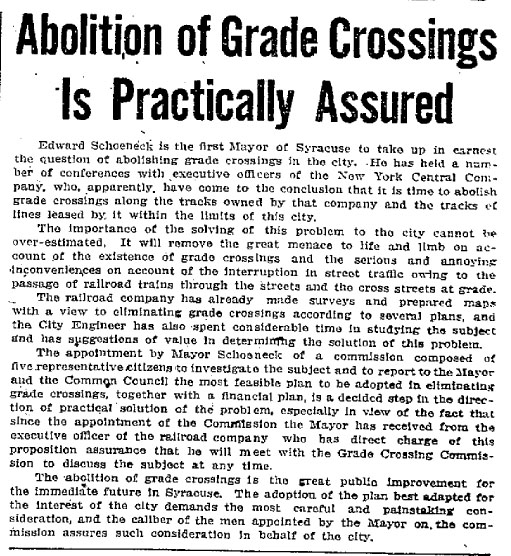
Mayor Edward Schoeneck yesterday took up the serious consideration of ways and means by which the removal of the New York Central tracks from Washington Street may be effected and a plan worked out by which scores of railroad crossings at grade may be abolished in Syracuse.

Mr. Schoeneck has had the matter under advisement for some time, according to statements made yesterday by members of his administration with whom he has discussed the question. He is said to have agreed with the declaration of Judge Irving G. Vann at the Chamber of Commerce banquet Saturday evening that the time is at hand when definite steps should be taken to secure the removal of the railroad tracks from the business center of Syracuse. (Post-Standard, March 22, 1910).

Not much had changed regarding grade crossing elimination since McGuire’s time: the grade crossing act required the railroad to pay for fifty percent of the solution, with the state and city covering the remaining half evenly. Of course, the cost of project had been revised, with the estimate increased to $4 million. Mayor Schoeneck felt “as much as Syracuse desired the removal of steam railway traffic from its streets, the city was neither able nor willing to assume a bonded debt of $1,000,000 to bring about the results” (Post-Standard, July 30, 1910). 


Post-Standard, May 15, 1907
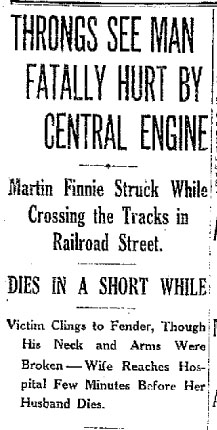
Another difference since McGuire’s time were the scores of additional injuries and deaths that continued to be caused by grade crossings. Although the New York Central Railroad had earlier insisted they were not contractually obligated to take any action on the Washington Street tracks until 1917, repeated headlines about amputated fingers and crushed legs could be considered as bad for the corporate brand. When Schoeneck met with New York Central President W.C. Brown in April 1910, he found the railroad chief to be more “liberal” towards the grade crossing situation:
 “President Brown showed a disposition to treat the matter in a broad and liberal spirit,” said the Mayor yesterday. “From his attitude I feel confident that we will be able to solve the grade crossing problem satisfactorily without recourse to the grade crossing act.” (Mayor Schoeneck, quoted in Post-Standard, April 4, 1910).

Brown and Schoeneck discussed alternative means of reimbursement for Syracuse’s share of expenses, including allowing the New York Central to buy a franchise of streetcars which would operate on East Washington Street, absolution of any costs incurred by the city associated with street closings during construction, and “the remission to the New York Central of taxes which would accrue to Syracuse as a result of the increased taxable valuation of its property here, incidental to the construction of a new station, the elevation of its tracks and other betterments and improvements.” (Post-Standard, July 30, 1910).

But it wasn’t only the expense of the project that caused unease for the Syracuse city leaders:


It was learned that the construction of an elevated structure by the West Shore route was the basis of discussion. City Engineer [Henry] Allen, it was ascertained later, impressed upon President Brown that the street crossings, particularly at North Salina Street, must be built to mar the street as little as possible and to avoid damaging adjacent property.
It was pointed out that in the case of recent elimination of grade crossings in Schenectady, that State Street, the city’s main thoroughfare, had suffered severely in its most important part. There, the heavy, closely built elevated structure practically shuts off all overhead light from the underlying street. These points, it is understood, were made note of by Mr. Brown, who gave his assurance that the cross streets would be marred in no way by the change. (Post-Standard, April 2, 1910).

Almost a year after Mayor Schoeneck first met with the New York Central, the city announced that two plans that had been submitted to the railroad for considerationessentially the same two plans that been considered twelve years earlier. The Post-Standard expected the possibility of elevated tracks might cause a “warm controversy”:

A decision on the two plans to be offered will be reached only after a warm controversy. Opposition to the elevation of the West Shore tracks has already been voiced by the First and Second Wards Citizen Improvement Association and the North Side Citizens Association.
...
Residents of the North Side have taken the position that elevated tracks along the West Shore route would be unsightly, and that they would form a wall dividing the city into two parts more effectually than does the Erie canal. The division, they contend, being farther to the north than the canal, would be detrimental to the development of the North Side. (Post-Standard, February 17, 1911).

former Schoeneck residence, 500 North McBride Street
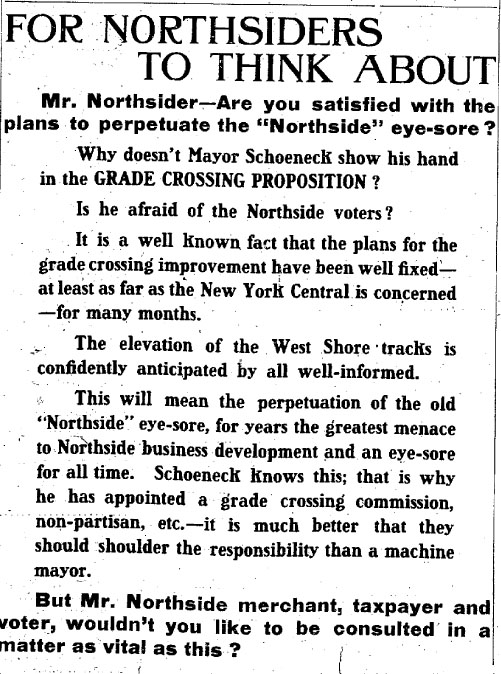
The issue may have been particularly sensitive to Schoeneck, a resident of North McBride Street.  Endorsement of elevation would not only alienate constituents, but his own neighbors. As the election year continued (at the time, mayors served 2-year terms), grade crossing elimination had become the most unique of political issues: while the progress Schoeneck had made with the New York Central railroad had been the most substantial in twenty years, any public support of the West Shore Elevation plan could lose potential voters.  Schoeneck, perhaps sensing this precarious position, asked the Common Council to approve the creation of a Grade Crossing Commission:

The five men who form the Grade Crossing Commission, which the Common Council authorized Mayor Schoeneck to appoint, are Alan C. Fobes, former mayor of the city; Henry H.S. Handy, president of the Chamber of Commerce; Alexander T. Brown, manufacturer, capitalist and inventor; Albert J. Will, manufacturer, and John T. O’Brien, labor representative.
The commission, under the ordinance that the Common Council adopted, authorizing its appointment by the mayor, is directed to investigate not only the physical plan of doing away with the crossings at grade, but also to take into consideration the question of the financing of the project. The commission has no authority under the ordinance to bind the city, but is directed to investigate and make report of its investigations to the Common Council (Syracuse Herald, October 18, 1911).

from Schoeneck campaign ad, Syracuse Herald, October 31, 1911
Democratic Aldermen in the Common Council voted against the ordinance to create the commission, as the Schoeneck-named commission could be in place for years. However, Alderman Patrick Cawley of the First Ward (residing at 617 Bear Street) had his own reasons for voting no:

“It is said that it is an absolute fact,” Cawley declared, “that Mayor Schoeneck and the New York Central have entered into an agreement by which the tracks of the West Shore railroad will be elevated and will in consequence, greatly damage the principal streets of the city.”
He said he understood that the plan that had been agreed on would damage James and Salina street and would cut the city in two. He referred to the elevation in Rochester as an argument against the same procedure in the city. “I am against any ordinance that is going to damage Syracuse and divide the North and the South side. We want a united city. We don’t want an elevated road over the main streets.” (Syracuse Herald, October 10, 1911)

From Ludington campaign ad, Syracuse Herald, November 2, 1911
Democratic mayoral challenger James Ludington contended that the Commission was a political maneuver to avoid a public statement on the elevation issue:

“If it is true that the plans for the elimination of the grade crossings have been practically agreed on, as they say they have, you have a right to know now before election what the plans are. If he has a plan that will divide the North side and the South side you have a right to know.” (Ludington, at an speech at Hoffman Hall, 303 North Salina Street, quoted in Syracuse Herald, November 1, 1911)


Schoeneck won re-election, serving a second term as mayor until 1913 (and later as lieutenant governor of New York from 1915-1919). By the time of the election for Syracuse’s next mayor, the issue of grade crossing eliminationmore specifically, track elevationhad progressed from a “warm controversy” to “the hottest municipal row in the history of Syracuse” (Syracuse Herald, March 11, 1914) . And not only would the next mayor state his opinion on the matter for the public record, he would turn the cause into a battle for Syracuse’s future.

Thursday, February 17, 2011

February 1901

As Syracuse approaches the 75th anniversary of the elevation of the railroad tracks, this blog will revisit the history leading up to this most divisive decision. Call it (Dis)Union Station, if you will.


In all my trip in the West I saw no city situated as is Syracuse is in the matter of railroads. The railroads invariably along the line of the Southern Pacific, where the towns are new and the railroad controls the town, either did not go into the heart of the city or were raised or depressed. (Mayor James McGuire, quoted in Post-Standard, May 6, 1901)
Grade Crossing Elimination in Rochester, Sunday Herald, April 23, 1899

While Syracuse has been known for having some staggeringly long lead times for its municipal projects, perhaps none quite matches grade crossing elimination. By 1900, Syracuse had managed to build miles of sewers and paved roads, but could not remove grade crossings in the city, most notably on Washington Street. As pictures and postcards of the era captured, the New York Central Railroad ran down the center of Washington Street, sharing the road over the years with streetcars, horses, wagons, buses, autos and pedestrians. Syracuse wasn't alone as a city with dangerous grade crossings, but some of these other upstate cities, such as Rochester,
had elevated their rail tracks by the turn of the century. Mayor James McGuire, referred to as "The Boy Mayor" due to being only 27 years old at the time of his election in 1896, made grade crossing elimination a priority. In 1899, the city hired a renowned engineer, Henry B. Seaman, to propose a solution to the city's grade crossing problem. In April 1899, the Evening Herald announced the news that Seaman had arrived at a solution for the abolition of grade crossings:


Engineer Seaman has proposed two plans after the exhaustive study of the conditions. One of these, which he regards as the most desirable, is known as the West Shore plan, because, while it sends no freight trains through the city, it contemplates the elevation of the West Shore tracks for the use of the passenger trains of the Central, the West Shore and the Chenango Valley roads. The other plan, which is based on the suggestion of William R. Hill, Chief Engineer and Superintendent of the Water Department, contemplates the bringing of the passenger trains of these roads, like those of the Rome, Watertown and Ogdensburgh road, into the city, from the north and the northwest by means of a loop from tracks north of the city, the West Shore tracks, as well as the Central tracks in Washington Street, being abandoned.
drawing from Henry B. Seaman's plan, Evening Herald, April 10, 1899
 
Granted, this would be no small undertaking:

The plans presented provide for a stupendous public improvement, and the accompanying estimates show the cost will be two and a half millions of dollars [sic]. According to the State law, one half of the expense of abolishing grade crossings is borne by the railroad companies, one-fourth by the State, and one-fourth by the city.  (Evening Herald, April 10, 1899)

Although Mayor McGuire mentioned the elimination of grade crossings in his speech accepting the Democratic nomination for re-election six months later, by 1901, not only had no progress been made, but the state proclaimed that it only had $100,000 to contribute to Syracuse for such a project:


The words of the annual report of the Board of Railroad Commissioners of New York State, as made public yesterday, are important in the grade crossing discussion. Referring to Syracuse, the report says:

The subject of the abolishment of grade crossings of the railroads in the city of Syracuse has been under consideration in that city. The board has had some correspondence with the city on this subject, and has had filed with it a general plan for the work.

It is evident, however, that the cost will be so great that the appropriation made by the State [$100,000], even though it were entirely apportioned to the city of Syracuse, would not be sufficient in any one year to pay the State’s proportion of the expenses. (Post-Standard, January 16, 1901)

One week later, when a Post-Standard reporter asked Edgar Van Etten, Superintendent of the New York Central Railroad, about the railroad’s assistance in grade crossing elimination in Syracuse, Van Etten asked why the railroad should even consider such a question:


“In the first place,” said Mr. Van Etten, “there is little reason why we should take active steps in this matter and spend millions of dollars as long as we have the right of way through Washington Street for nearly twenty-five years more. It will be remembered that not many years ago the New York Central paved and reconstructed its tracks from Pine Street to the station at Franklin Street. In round numbers this work cost about $150,000 and the new station which was constructed about the same time cost not less than $270,000.

I know of no corporation that is fond of spending this amount of money and then do the work all over again in the course of a few years at a still greater expense. When we placed the street in its present condition there was a contract drawn up giving us the right of way for twenty-five years.” (Post-Standard, January 24, 1901)

Mayor McGuire appeared undaunted by this revelation, still hoping to enlist the assistance of the New York Central in the grade crossing elimination project. This brief one-sentence news item appeared in the Feb. 3, 1901 edition of the Post-Standard:

Mayor Inquires About Grade Crossings
The Mayor has again written to S.R. Callaway of the New York Central to see if the Central is going to act in the matter of abolishing grade crossings.

One week later, the Mayor received his reply:


New York, Februrary 7, 1901

Honorable James K. McGuire, Mayor of Syracuse, N.Y.:

Dear SirI am in receipt of your favor of the 31st ultimo, with reference to grade crossings in your city. My absence from the city has prevented an earlier reply.

This company is extremely anxious to abolish all dangerous grade crossings as rapidly as possible and is constantly spending large sums of money for that purpose. The plans of the Board of Railroad Commissioners have uniformly had our approval and active-cooperation. We have also gladly united with municipalities for the same purpose in any improvement which could be made on fair terms, as in the case of Albany, to which you refer.

I have every reason to believe that the directors would authorize a similar course in Syracuse, but the expense would be so large as to constitute a considerable burden upon the city as well as a much larger one upon the company.

I therefore asked you, at the conference which I had with yourself and other representatives of Syracuse, to advise me what share of the cost, in your city, the city would consent to bear. I understand that you expected to take this inquiry under consideration and give me an answer, but I have not yet received one.

The answer to this inquiry is especially pertinent and important because the company has so recently incurred a large expense in satisfying what it believed to be the wishes of the people of your city.

Callaway continues on, explaining the right-of-way contract that had never been mentioned at the time of the 1899 Seaman plans, despite being signed only seven years earlier:


As you are aware, the right to use Washington Street was granted to the predecessors of this company many years ago. The meaning of some expressions in the grant was at times the subject of some contention between the city and the company, and as lately as 1892, when the city was desirous of having Washington Street repaved and the freight facilities of the company increased and a new passenger station built, the city and company, after much deliberation, entered into an agreement under which it paved Washington Street with first class stone pavement on a concrete foundation, according to the plans of your City Engineer, laid a new rail in the same street and agreed in the future to remove all snow and ice from its tracks so that the street should not be obstructed.

It also agreed to enlarge its freight facilities and within two years to construct a new passenger station suitable to the needs of the city. It has carried out this agreement in good faith and your people expressed their approval of the plans of the station which was soon after completed.

In consideration of this action on the part of the company, the rights of the company in the street were confirmed and continued and it was relieved from all obligation in reference to paving for the ensuing twenty-five years.

In these circumstances, if we consent, after a lapse of less than nine of the twenty-five years, to take up the question of eliminating the grade crossings, the expense of the change should be divided between the public and the company upon some fair terms, and I shall be glad to have you indicate what portion of the cost the city would be willing to bear. You are, of course, aware that under the State law, the company bears one-half, the municipality one-quarter and the state one-quarter.

As a matter of fact, the accidents on Washington Street have been very few, and are confined almost wholly to cases where people have attempted to jump on the trains.

Yours truly,
S.R. Callaway
(Post-Standard, Feb. 10, 1901)

The situation proved to be quite baffling. Had Syracuse really entered into such a contract in 1892, a full decade after Rochester had eliminated their grade crossings by elevation? Would Syracuse be stuck with a train running through the center of its city until 1917, at the earliest?  Mayor Jacob Amos, who had entered the contract with the railroad, wrote an article for the Post-Standard one month later on March 17, 1901, explaining how the deal came to be:


It has been customary for the different city administrations for a good many years to antagonize the New York Central Railroad Company and try to compel it to do certain things in a way that did not bring good results. They tried, even, to have the company plank between its tracks east of State Street, which it absolutely refused to do.

I discovered that we could not compel the company to make any improvements, as under its franchise we could only compel it to keep the street in proper repair. The phase “proper repair” is a misnomer and means practically nothing. That is a construction that was given to it in the high courts.

Mr. Vanderbilt and Dr. Depew came here on a special train to see me and I asked them not only to pave Washington Street to State Street, but to do so for the entire length of the street, also to erect a new station and make improvements in their freight yard and in their freight house.

After consulting with them a number of times, they agreed to comply with all these requests if we would release them from further paving the street for a term of twenty years, they to repair any part of the pavement that they might destroy. This I considered a good contract since we could not compel them to pave the street.

While Mayor Amos had accomplished much during his two terms as mayor, including completing the municipal water system (started under Mayor Kirk) and introducing a new sewer system into the city, his negotiating power could never have matched the first tycoon, Cornelius Vanderbilt. Yet this may very well have been a good contract in Mayor Amos’ view, as his main concern was paving Washington street, and not grade crossing elimination:


In relation to eliminating the crossings in the central part of the city, I do not think at this time there is any very great demand from the citizens of Syracuse to do away with the tracks and also with the new station. Attention has been called to that improvement, and I have no doubt in time it will be done, but how soon I cannot say.

He also, perhaps, did not want to be the mayor associated with elevation:


There is quite a question in my mind if the citizens of Syracuse would like an overhead structure over James Street that would last us practically during this whole generation. They might want to have that changed again in ten or fifteen years.

Mayor Amos concluded his editorial by informing the citizens of Syracuse that they were essentially powerless in the face of the relatively new entities of corporations:


I have come in contact in the past few years with very large corporations, and it has been my observation that little is to be gained by trying to force these large companies when the matter is beyond your control, as is the case with the New York Central.

As a citizen I take just as much interest in any improvements for Syracuse as I did when I had more authority. To use a homely expression, “You can catch more flies with molasses than you can with vinegar.” In this case, the New York Central cannot be compelled to do away with its grade crossings unless the city and state carry out their part as laid down by law.

The idea that the city could “catch more flies with molasses” led to slippery slope between acceptance and accommodation, as this editorial by Milton H. Northrup, former Syracuse postmaster and editor of the Syracuse Courier, clearly demonstrates:


The Central-Hudson Railroad owes much to Syracuse, it is true; but what does the city owe to the railroads which center here? What built up Syracuse to a city of an eighth of a million inhabitants at the close of its first half century? Was it the Erie Canal? If so, why do our citizens look with such complacency to the proposition to deprive us of the canal altogether, moving its line miles to the north?...Was it the salt works? They, too, were important factors but they have ceased to be regarded as essential to the city’s life and growth. Take them away altogether, along with the canal, and Syracuse would go on just the same.
But suppose the cities were to be stripped of its railroads: Suppose we had but one within ten miles, where would Syracuse be then? The railroads were the pioneers of our civilization and progress. They are the pillars on which our growth and prosperity rest. We can no more afford to antagonize them than could the members of the body, as described by Esop of old, afford to rebel against the stomach. The obligations are reciprocal, and no horseplay to the galleries should be permitted to array the two in hostility.

Some will ask what all this has to do with the change of grade of the Central-Hudson tracks, by elevation or depression. Nothing, I grant. That is a question sooner or later to be metgrade crossings must be abolished. But this will not be brought about by a policy of bulldozing or bluff. Whatever right to our streets comes by priority of possession belongs to the railroad corporation and not to the city. The railroad came first, and when the city came later it found the tracks already down and trains running over them. Under such conditions the Mayor’s policy of coercion seems unlikely to win. An appeal to the company’s sense of justice and good will might bring better results. (Post Standard,March 3, 1901)

While Mr. Northrup argued for the importance of railroads based on the obsolescence of earlier markers of Syracuse history, he failed to comprehend the same could be true for railroads in the future.  If the corporate railroads were the pillars of Syracuse, once they disappeared, Syracuse would be left with, well, pillars. (Or, in a related scenario, concrete bunkers attached to malls.)


***

Shortly after Mayor McGuire received his reply from the New York Central Railroad, he took a two-month leave of absence due to his health:


Mayor McGuire said last night that he would probably leave Sunday for Las Vegas hot springs, New Mexico  where he will remain two months for his health. The trip is being taken by the advice of his physician. The Mayor says he has never fully recovered from the illness he contracted while he was in the South. (Post Standard, February 22, 1901)

McGuire returned nine and a half weeks later (during which time, the president of the common council, Martin Yann, acted as interim mayor) and completed his term, but lost a re-election campaign to Jay Kline. Sadly, the “Boy Mayor” died unexpectedly of a heart attack in 1923, with grade crossing elimination still more than a decade away.