As well reported and celebrated, twenty years ago, on October 15, 1990, Carousel Center opened its doors and changed the shopping landscape of Syracuse forever. Not surprising, another landscape-altering mall's October 15 birthday passed with no fanfare, much like it has for the past 23 years.

Monday, October 18, 2010


Sunday, September 12, 2010
August 30, 2010
(Continued from Part 1)
In the late 1940s, the Parking Authority made small gains in their parking mission. In 1949, municipal parking lots opened on the northern and southern edges of downtown, at the corner of Oswego Boulevard and North Salina Street and Oneida and West Adams Streets. Each lot offered approximately 200 spaces. But as the Post-Standard had predicted several years earlier, the number of cars on the streets of Syracuse was increasing exponentially. Furthermore, building materials were no longer in short supply as they had been in the years immediately following WWII, resulting in a burst of suburban home and business construction. Yet despite this rapid growth, the Parking Authority's 1950 proposed parking site was decidedly retro:

Despite being shot down for a similar proposal two years earlier, the Parking Authority resurrected their wish to use Clinton Square for parking, though this time around they added Forman Park to the mix as well. According to a June 21, 1950 Post-Standard article, the authority had "abandoned all thoughts suggested last year of double- and triple-decker parking facilities preferring to use street level accommodations solely." In other words, perhaps in an effort to mimic the suburban parking lots, the parking authority sought open land where there was none. As the Post-Standard realized, "Fayette and Columbus parks and other similar spots of green in the community appear in danger of elimination to serve as space for cars."
Granted, Syracusans may have loved their cars, but they didn't want "the sight of 62 cars, even though all are of the latest model" taking over the downtown parks (from letter to the editor, Post-Standard, June 20, 1950). Residents took up their pens in protest:
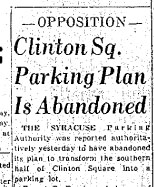
Letters appeared daily on the editorial pages, as well as editorials from both the Post-Standard and Herald-Journal condemning the decision. Initially, even in the face of this opposition, Mayor Thomas Corcoran "sided with the authority, declaring parking space is more necessary than beauty, especially when it will produce revenue from parking meters." (Post-Standard, June 22, 1950). But exactly one week after the triumphant headlines, the Sunday paper carried far different news:
The following week, the paper once again confirmed the news, stating that "the Parking Authority will meet Thursday to reject the proposal for converting Clinton Square and Forman Park into municipal parking lots" (Syracuse Herald-American, July 2, 1950). When you consider this swift reconsideration by the city after the overwhelming protest by Syracuse residents, you can't help but wonder if the razing of buildings that occurred during the urban renewal years would have had a different outcome had there been similar unified outrage. Unfortunately, the answer can be found within the same letters and editorials:
***
By 1953, the downtown parking situation had become so dire that a 15-part (yes, fifteen part) series about the problem was published in the Post-Standard. In Part 1, reporter Luther Bliven summarized the problem quite succinctly:
Unfortuntately for Mr. Bliven and the Post-Standard, the next 14 articles in the series weren't devoted to reimagining downtown as an alternative to the suburbs, but rather, the hopeless cause of trying to compete with suburban parking. Certainly, Bliven engaged in an extensive amount of research:
Bliven's final recommendation? "Private individuals—investors, bankers or real estate men—should promote construction of one or two ramp garages to accommodate 800 cars." (Post-Standard, May 3, 1953) 15 articles and countless hours of interviews and research, and Bliven thought the problem could be solved with an 800-car garage? Six months earlier, an A&P had opened at the new Valley Plaza, highlighting its 800-car parking lot:
Suburban supermarkets and shopping centers routinely advertised the availability of free parking, almost mocking the downtown situation:
Granted, 800 cars probably never parked at Valley Plaza, and an 800-car garage downtown would have gone a long way to alleviating the parking shortage for shoppers and workers. But drivers weren't relating to numbers, but promises:
800 or 8,000 car garage: the numbers made no difference. Downtown could never guarantee a parking spot steps from the store as the suburbs could. Bliven concluded as much in Part 2:
The knotty problem still remains, as "lack of parking" continues as a reason to avoid downtown to this day, despite the fact that no one has ever seemed to skip a concert or celebrating in Armory Square for lack of a parking spot (except perhaps the 30 O'Brien & Gere employees who had never been downtown, who really need a 15-part series of their own). Yet now as downtown starts to show new signs of life, the parking excuse may start to hold some truth.
Although one of O'Brien & Gere's "downtown orientation sessions" focused on Centro and bike commuting, one would surmise that the majority of the 350 employees of O'Brien & Gere will drive downtown. Winter snow and ice would sideline all but the most experienced bike riders, and Centro—like most city bus systems—limits its riders to schedule and routes. Similarly, one would assume that the majority—if not all—of the condo dwellers downtown also own cars, as the act of buying groceries seems difficult otherwise. As more buildings are converted to condos, and more businesses move downtown, how will this be sustainable? With no convenient alternative means of transportation to and from downtown, how is this any different than sixty years ago?
The recent Post-Standard article about the new O'Brien & Gere downtown office offers walkability as a motive for relocation:
What is unclear, however, is where this walkability begins and ends. Should Downtown merely be a driving destination that is walkable? Or should it be more reflective of its heyday, when downtown was the crossroads of a city connected by streetcar lines? While there seems to be great excitement into turning Downtown into a full-fledged neighborhood (complete with proposed grocery store in the old Dey's building), how would a Downtown dweller travel to any other neighborhood in the Syracuse area without his/her car? Should the "50 to 70 [O'Brien & Gere] visitors a day — customers and out-of-town employees" be required to rent cars or take taxis? And in these respects, how would a revived downtown be any different than a thriving suburb?
***
In the years immediately following WWII, Syracuse couldn't consider city planning without cars as the central focus, as doing so would be a step away from a culture fixated on the future. Technology had won the war; how could it not solve a simple problem like parking? Thus the Strand Theater demolition for a mechanical parking garage, never giving thought to the simple problem that if everyone left an event at the same time, waiting for your car to arrive via elevator might be inconvenient. When the elevated portion of the "modern expressway" finally materialized, city leaders seemed more enamored with the availability of parking underneath. And in the throwback to the war years, when factories were converted for use towards the war effort, a 1974 proposal to build a new library to house a parking garage:

The math has never worked on downtown parking because cars were never meant to be part of the downtown equation. Downtowns have tried to adapt, with parking garages and lots, but what results is a confused hybrid of suburban shopping center and downtown, or more appropriately, a city that can't pinpoint its soul. After suffering from this stigma for decades, downtown is now considered "poised" for a comeback. But for all the new development, if the answer to this one old piece of business isn't thoroughly discussed, that little park at Fayette and West street might become "a gathering point" for a revitalized city center...as downtown's newest parking lot.
"Some years ago the center of the city, namely Clinton Square, was devoted to the parking of cars and the appearance of the city at that place where it should look best to the person driving through was a mess. Now after creating a thing of beauty there to eliminate that horrible mess, our elected officials again want to mess up that spot just to park a measly 60 cars. How thrilling! Just think, all of sixty cars; not a drop in the bucket. It shows a great deal of advancement. Actually, it shows the thinking of small children." (excerpt from a letter to the editor written by Merritt G. Curtis, Syracuse, Syracuse Herald-Journal, June 20, 1950)
In the late 1940s, the Parking Authority made small gains in their parking mission. In 1949, municipal parking lots opened on the northern and southern edges of downtown, at the corner of Oswego Boulevard and North Salina Street and Oneida and West Adams Streets. Each lot offered approximately 200 spaces. But as the Post-Standard had predicted several years earlier, the number of cars on the streets of Syracuse was increasing exponentially. Furthermore, building materials were no longer in short supply as they had been in the years immediately following WWII, resulting in a burst of suburban home and business construction. Yet despite this rapid growth, the Parking Authority's 1950 proposed parking site was decidedly retro:

Despite being shot down for a similar proposal two years earlier, the Parking Authority resurrected their wish to use Clinton Square for parking, though this time around they added Forman Park to the mix as well. According to a June 21, 1950 Post-Standard article, the authority had "abandoned all thoughts suggested last year of double- and triple-decker parking facilities preferring to use street level accommodations solely." In other words, perhaps in an effort to mimic the suburban parking lots, the parking authority sought open land where there was none. As the Post-Standard realized, "Fayette and Columbus parks and other similar spots of green in the community appear in danger of elimination to serve as space for cars."
Granted, Syracusans may have loved their cars, but they didn't want "the sight of 62 cars, even though all are of the latest model" taking over the downtown parks (from letter to the editor, Post-Standard, June 20, 1950). Residents took up their pens in protest:
To the Herald Journal:
A characteristic nibble at the edge of a big problem is the plan to turn Clinton Square into a parking lot. Syracuse is still trying to run a big city on a country village level.
The Square, which is not only a welcome spot of beauty in a rushing downtown section, but is supposed to have some memorial significance, will park a few cars, true. But it will certainly not improve the beauty of our city, which the planners praise about, when it is turned into a car lot.
Syracuse is still living down the reputation as the town where "the trains run through the streets." Now it can build up another as the city which uses its Soldiers and Sailors Memorial Square for a parking lot. (from a letter signed Cross-Town Pedestrian, June 20, 1950)
To the editor of the Post-Standard:
The following is a letter I have sent to Mayor Corcoran:
As a descendant of two of the pioneers of Syracuse, I wish to add my protest to the many others you have received, against the destroying of two of the few remaining beauty spots now left in downtown Syracuse: namely, the fountain in Clinton Square and Forman Park, established in honor of another of the founders of our city.
My ancestor, Oliver Teall, was one of the engineers instrumental in building the Erie Canal through this area.
My father, Timothy H. Teall, exhibited the first electric light in Syracuse.
It will take a lot of parking revenue to reimburse the taxpayers for the cost of the Clinton Square fountain, as was reported in this week's paper. Then, too, we will not have a little place for our municipal Christmas tree, which is one of the pleasant items in a cold winter. Don't sacrifice everything for a little more money.
Also, have you the legal right to destroy our property?
(from a letter signed H.L. Teall, Post-Standard, June 27, 1950 - also printed in Syracuse Herald-Journal, June 28, 1950)
Letters appeared daily on the editorial pages, as well as editorials from both the Post-Standard and Herald-Journal condemning the decision. Initially, even in the face of this opposition, Mayor Thomas Corcoran "sided with the authority, declaring parking space is more necessary than beauty, especially when it will produce revenue from parking meters." (Post-Standard, June 22, 1950). But exactly one week after the triumphant headlines, the Sunday paper carried far different news:
 |
| From Syracuse Herald-American, June 25, 1950 |
The city has broached the idea of turning Forman Park and part of Clinton Square into parking areas.
It is simply an admission of defeat.
There are plenty of ramshackle old buildings that could be torn down in congested areas and the sites turned into parking spaces, without turning to the few bits of nature that Syracuse owns. (from Post-Standard editorial, June 20, 1950)
To the editor of the Post-Standard:
I wish to protest against the plans of the city to use part of Clinton Square and Forman Park for parking lots. Why couldn't some of the old unsightly buildings in the downtown area be condemned and torn down and the land used for parking areas, thereby improving the community. (from letter signed J.B., Post-Standard, June 25, 1950)
To the Herald-Journal:
Why don't we tear down some of the ramshackle old buildings around town and build a real building for parking of cars instead of making an ugly blot out of that little beauty spot and putting us back in the horse and buggy era. (from a letter signed Isha, Herald-Journal, June 24, 1950)
***
By 1953, the downtown parking situation had become so dire that a 15-part (yes, fifteen part) series about the problem was published in the Post-Standard. In Part 1, reporter Luther Bliven summarized the problem quite succinctly:
The average driver is an eternal optimist, certain that if he keeps circling long enough he will find a parking space reasonably near where he wants to go. If parking is completely prohibited in the area of his destination, he may have a passenger go in and do his errand. Meanwhile he circles the block until the errand is completed. Both maneuvers produce more traffic congestion.
...
Unless the people can enter and leave the central business district without being unduly delayed by traffic congestion, and can find a place to park reasonably near their destination, they will purchase merchandise and commercial and professional services elsewhere, usually in suburban shopping centers. (Post-Standard, April 19, 1953)
Unfortuntately for Mr. Bliven and the Post-Standard, the next 14 articles in the series weren't devoted to reimagining downtown as an alternative to the suburbs, but rather, the hopeless cause of trying to compete with suburban parking. Certainly, Bliven engaged in an extensive amount of research:
During his preparation of the series, Mr. Bliven compared the Syracuse situation with that of 15 other cities from coast to coast; analyzed reports on the problem prepared by Syracuse and other cities; held personal interviews with more than 30 Syracusans closely acquainted with the parking and traffic needs of the city.
He also consulted at length with two nationally-recognized authorities on the subject; interviewed 23 persons in Allentown and Philadelphia, Pennsylvania; corresponded with municipal, chamber of commerce and merchants' parking group authorities in 12 other cities; studied articles dealing with the subject in such magazines as Architectural Forum, Life, Collier's and other publications; conferred with many persons who have called in with suggestions since the series started. (Post-Standard, May 3, 1953)
Bliven's final recommendation? "Private individuals—investors, bankers or real estate men—should promote construction of one or two ramp garages to accommodate 800 cars." (Post-Standard, May 3, 1953) 15 articles and countless hours of interviews and research, and Bliven thought the problem could be solved with an 800-car garage? Six months earlier, an A&P had opened at the new Valley Plaza, highlighting its 800-car parking lot:
 |
| Post-Standard, December 3, 1952 |
Suburban supermarkets and shopping centers routinely advertised the availability of free parking, almost mocking the downtown situation:
 |
| from A&P ad, Post-Standard, December 3, 1952 |
Granted, 800 cars probably never parked at Valley Plaza, and an 800-car garage downtown would have gone a long way to alleviating the parking shortage for shoppers and workers. But drivers weren't relating to numbers, but promises:
 |
| Syracuse Herald-Journal, February 14, 1951 |
800 or 8,000 car garage: the numbers made no difference. Downtown could never guarantee a parking spot steps from the store as the suburbs could. Bliven concluded as much in Part 2:
The city's parking shortage and traffic congestion problems are compounded by the fact that 70 percent of more than 30,000 drivers who enter the main business area daily insist on parking at the curb where only about one-seventh of the total downtown parking space is available.
Many who would gloss over the knotty problem maintain, "the parker must learn to walk a few blocks farther." Extensive studies in Syracuse, and many other cities, show he is not inclined." (Post-Standard, April 20, 1953)
The knotty problem still remains, as "lack of parking" continues as a reason to avoid downtown to this day, despite the fact that no one has ever seemed to skip a concert or celebrating in Armory Square for lack of a parking spot (except perhaps the 30 O'Brien & Gere employees who had never been downtown, who really need a 15-part series of their own). Yet now as downtown starts to show new signs of life, the parking excuse may start to hold some truth.
Although one of O'Brien & Gere's "downtown orientation sessions" focused on Centro and bike commuting, one would surmise that the majority of the 350 employees of O'Brien & Gere will drive downtown. Winter snow and ice would sideline all but the most experienced bike riders, and Centro—like most city bus systems—limits its riders to schedule and routes. Similarly, one would assume that the majority—if not all—of the condo dwellers downtown also own cars, as the act of buying groceries seems difficult otherwise. As more buildings are converted to condos, and more businesses move downtown, how will this be sustainable? With no convenient alternative means of transportation to and from downtown, how is this any different than sixty years ago?
The recent Post-Standard article about the new O'Brien & Gere downtown office offers walkability as a motive for relocation:
A new generation of employees wants something else, said Dot Hall, a senior manager. Surveying college graduates who declined O’Brien & Gere job offers, Hall learned they wanted to work in cities where they can walk to restaurants, shops and entertainment.
What is unclear, however, is where this walkability begins and ends. Should Downtown merely be a driving destination that is walkable? Or should it be more reflective of its heyday, when downtown was the crossroads of a city connected by streetcar lines? While there seems to be great excitement into turning Downtown into a full-fledged neighborhood (complete with proposed grocery store in the old Dey's building), how would a Downtown dweller travel to any other neighborhood in the Syracuse area without his/her car? Should the "50 to 70 [O'Brien & Gere] visitors a day — customers and out-of-town employees" be required to rent cars or take taxis? And in these respects, how would a revived downtown be any different than a thriving suburb?
***
In the years immediately following WWII, Syracuse couldn't consider city planning without cars as the central focus, as doing so would be a step away from a culture fixated on the future. Technology had won the war; how could it not solve a simple problem like parking? Thus the Strand Theater demolition for a mechanical parking garage, never giving thought to the simple problem that if everyone left an event at the same time, waiting for your car to arrive via elevator might be inconvenient. When the elevated portion of the "modern expressway" finally materialized, city leaders seemed more enamored with the availability of parking underneath. And in the throwback to the war years, when factories were converted for use towards the war effort, a 1974 proposal to build a new library to house a parking garage:

The math has never worked on downtown parking because cars were never meant to be part of the downtown equation. Downtowns have tried to adapt, with parking garages and lots, but what results is a confused hybrid of suburban shopping center and downtown, or more appropriately, a city that can't pinpoint its soul. After suffering from this stigma for decades, downtown is now considered "poised" for a comeback. But for all the new development, if the answer to this one old piece of business isn't thoroughly discussed, that little park at Fayette and West street might become "a gathering point" for a revitalized city center...as downtown's newest parking lot.
Monday, August 23, 2010
August 14, 1945
"You've lost. You just don't know it."
"I've lost? Look at the board."
"I have."
—scene from the film Searching for Bobby Fischer
On August 14, 1945, upon the news of Japan's surrender in World War II, "crowds of persons streamed downtown as if pushed by an avalanche":
Downtown Syracuse was the centerpiece of a celebration, not only of the end of the war but of the prosperity to follow: one year earlier, General Electric announced the construction of Electronics Park, the main manufacturing center of the General Electric electronics department. The 10 million dollar project covering 155 acres and 1 million square feet of floor space was so massive that "nothing in Syracuse [could] touch it for size and modernity." (Syracuse Herald-American, September 23, 1945). On June 23, 1945, a Syracuse Herald-Journal editorial addressed the "bright days ahead for our city":
Yet on the very same page, one column to the right, another Herald-Journal editorial glimpsed a possible shadow on this glowing future:
They most certainly would be unique among American cities, as they would be achieving the impossible: fitting thousands of cars within steps-only walking distance of every downtown shop, while still trying to maintain the existence of downtown. By the mid-1940s, editorial writers realized that that even the high-tech innovations of Electronics Park couldn't solve the low-tech issue of downtown parking:
They also glimpsed what the success and growth of post-WWII Syracuse could mean for downtown:
In the years and decades ahead, downtown would experience that loss: loss of business, loss of buildings, loss of the very institutions—the grand movie palaces and theaters—that could have offered the city center a competitive edge over the suburbs. Indeed, when we think of what could have been, it's easy to imagine touring Broadway shows at RKO Keith's or the Strand Theater, drawing Wicked-sized crowds to Downtown on a monthly basis. But just think: there may also have been no Connective Corridor or Clinton Square fountain use to debate; no Urban Outfitters or O'Brien & Gere grand openings to gush over. Not because downtown would have been such a glittering jewel that we wouldn't need year-long orientation sessions for its newest employees, but rather, had certain Syracuse citizens not been victorious in their own personal battles for downtown, Forman Park, Clinton Square and Armory Square today would be supersized parking lots.
***
In 1947, Mayor Frank Costello named a five-member commission (Charles Chappell, Henry Menopace, president of the Syracuse Real Estate Board, Frederick Norton, secretary of the Chamber of Commerce, Jerome Rusterholtz, automobile dealer, and G. Frank Wallace, businessman and former state senator) to solve the city's parking problem. The announcement of the new authority came in conjunction with the release of a report of an off-street parking program prepared by the City Planning Commission, which made several suggestions for permanent parking facilities:
View 1947 Parking Solutions in a larger map
Although subterranean parking lots were then being constructed in other cities, the report declared the proposal of building garages under streets or parks downtown "impractical." Yet, really, none of the suggestions in the report could be considered practical, as the city had neither means nor method for advancing this plan. After a year of much talk and no action, perhaps the Syracuse Herald-American could be forgiven for not believing the Authority's announcement of a new potential solution as particularly newsworthy:
Clinton Square had once before been used solely for parking, in the years immediately following the paving-over of the Erie Canal. In 1933, the city embarked upon the "beautification of Clinton Square," based on plans submitted by architect Dwight Baum:

Perhaps it is easier to understand how the Strand Theater and similar historic landmarks could be sacrificed in the 1950s when you read that a mere decade after this landscaping makeover, Clinton Square was offered up for an 62-car parking lot. Sensing a battle, neighborhood garden clubs immediately voiced their disapproval:
The Syracuse Society of Architects protested the proposal, declaring the scheme "inadequate and would only serve to increase the traffic problem downtown and destroy one of the most prominent aesthetic areas of the city." (Post-Standard, January 30, 1948) Even a Post-Standard editorial decried the plan:
Within six months, the Parking Authority seemed to lose interest in Clinton Square, as they had arrived at at new possibility: razing a full city block to build a giant parking garage:
While the Jefferson-Clinton Hotel would be spared, other buildings—occupied with tenants—would be condemned and demolished for the structure, which offered the promise of being one block away South Salina Street:
On July 8, the Syracuse Parking Authority stated that in "about two weeks" they would take "concrete action to acquire the property and demolish buildings." (Post-Standard, July 8, 1948). One week later, the property formerly housing the St. Vincent Orphanage at Madison and Montgomery Streets, was offered to the city for purchase for a parking lot. Thus ended the plan to bulldoze this particular block, though once again the news was buried on the inside pages:

But when the Parking Authority announced their next proposed site, the plan sounded so audacious—or inept—that headlines would be splashed across the front page of the Sunday paper.
Coming soon: Part 2
The Post-WWII Emerald City: Razing parks but recycling ideas!
"I've lost? Look at the board."
"I have."
—scene from the film Searching for Bobby Fischer
On August 14, 1945, upon the news of Japan's surrender in World War II, "crowds of persons streamed downtown as if pushed by an avalanche":
 |
| Post-Standard, August 15, 1945 |
Downtown Syracuse was the centerpiece of a celebration, not only of the end of the war but of the prosperity to follow: one year earlier, General Electric announced the construction of Electronics Park, the main manufacturing center of the General Electric electronics department. The 10 million dollar project covering 155 acres and 1 million square feet of floor space was so massive that "nothing in Syracuse [could] touch it for size and modernity." (Syracuse Herald-American, September 23, 1945). On June 23, 1945, a Syracuse Herald-Journal editorial addressed the "bright days ahead for our city":
Remarks of District Manager Mason of the War Production Board in his address before the Advertising Club are profoundly encouraging from the standpoint of all citizens interested in postwar prosperity for Syracuse.
...
Not only are some of our largest industries planning broad expansion but new industries promise beneficent results from the standpoint of the community as a whole. For example, the General Electric Electronics Park development, which promises to become the world center of the electronics industry, will mean employment for thousands in postwar years.
These are bright days ahead for Syracuse.
Yet on the very same page, one column to the right, another Herald-Journal editorial glimpsed a possible shadow on this glowing future:
In planning for the postwar progress and prosperity of Syracuse, thoughtful consideration must be given to the problem of providing more adequate parking facilities in or near the business heart of the city.
...
The parking situation undoubtedly will grow progressively worse as more gasoline becomes available and new cars come into the market.
In its report covering the Central District of Syracuse, the Syracuse-Onondaga Postwar Planning Council remarked that "assurance of ample parking facilities is a matter of public responsibility. It does not make sense to provide public highways and streets for moving vehicles and make no provision for them at rest..."
...
We are aware, of course, that the parking problem is present in exaggerated form in practically every American city. Syracuse is not unique in that respect: it is in the same class as the majority of American municipalities.
But if we could solve this problem, it would be a momentous development from the standpoint of the city's future. Then we would be unique among American cities.
They most certainly would be unique among American cities, as they would be achieving the impossible: fitting thousands of cars within steps-only walking distance of every downtown shop, while still trying to maintain the existence of downtown. By the mid-1940s, editorial writers realized that that even the high-tech innovations of Electronics Park couldn't solve the low-tech issue of downtown parking:
There is not much use in trying to find more parking space at curbs in the business section of the city. There are five cars now for every space (at 45-minute intervals) and before long there will be 10 of them.
They also glimpsed what the success and growth of post-WWII Syracuse could mean for downtown:
The traffic laws are badly misused. But we should realize, too, that it is largely a result of desperation. There are many more cars than there are parking spaces.
If we do not solve the problem, we'll have stores scattering to different parts of the city. We'll lose heavily. (Post-Standard editorial, February 20, 1946)
In the years and decades ahead, downtown would experience that loss: loss of business, loss of buildings, loss of the very institutions—the grand movie palaces and theaters—that could have offered the city center a competitive edge over the suburbs. Indeed, when we think of what could have been, it's easy to imagine touring Broadway shows at RKO Keith's or the Strand Theater, drawing Wicked-sized crowds to Downtown on a monthly basis. But just think: there may also have been no Connective Corridor or Clinton Square fountain use to debate; no Urban Outfitters or O'Brien & Gere grand openings to gush over. Not because downtown would have been such a glittering jewel that we wouldn't need year-long orientation sessions for its newest employees, but rather, had certain Syracuse citizens not been victorious in their own personal battles for downtown, Forman Park, Clinton Square and Armory Square today would be supersized parking lots.
***
On nearly every street in the business section of Syracuse there are vacant lots once occupied by business blocks that are now torn down. These are mostly used as parking lots.
...
All over the city the same condition prevails. At the rate business buildings are being torn down, it will not be long before the entire downtown district will be one vast parking lot. (from a letter to the editor, Syracuse Herald-Journal, May 5, 1944)
In 1947, Mayor Frank Costello named a five-member commission (Charles Chappell, Henry Menopace, president of the Syracuse Real Estate Board, Frederick Norton, secretary of the Chamber of Commerce, Jerome Rusterholtz, automobile dealer, and G. Frank Wallace, businessman and former state senator) to solve the city's parking problem. The announcement of the new authority came in conjunction with the release of a report of an off-street parking program prepared by the City Planning Commission, which made several suggestions for permanent parking facilities:
View 1947 Parking Solutions in a larger map
Although subterranean parking lots were then being constructed in other cities, the report declared the proposal of building garages under streets or parks downtown "impractical." Yet, really, none of the suggestions in the report could be considered practical, as the city had neither means nor method for advancing this plan. After a year of much talk and no action, perhaps the Syracuse Herald-American could be forgiven for not believing the Authority's announcement of a new potential solution as particularly newsworthy:
 |
| "Parking may replace park." January 18, 1948 |
Clinton Square had once before been used solely for parking, in the years immediately following the paving-over of the Erie Canal. In 1933, the city embarked upon the "beautification of Clinton Square," based on plans submitted by architect Dwight Baum:

Perhaps it is easier to understand how the Strand Theater and similar historic landmarks could be sacrificed in the 1950s when you read that a mere decade after this landscaping makeover, Clinton Square was offered up for an 62-car parking lot. Sensing a battle, neighborhood garden clubs immediately voiced their disapproval:
To the Editor of the Post-Standard:
Enclosed is a letter sent to Mayor Costello.
Alan F. Burgess (President, Garden Center Association)
Recently some publicity has been given to a proposal to convert the southern half of Clinton Square to a parking lot, as a partial solution to the need for off-the-street parking.
I wish to inform you that at its regular monthly meeting today, the Garden Center Association, which represents 27 Garden Clubs in Syracuse and Central New York, voted unanimously to go on record as opposing this proposal, and to inform you of its action.
While we realize the need for increased parking space in downtown Syracuse, we believe that the proposed change in Clinton Square would actually provide space for a mere handful of cars, while detracting considerably from the appearance of this park, in the heart of our city.
There are already too many unattractive areas in Syracuse, without creating one more where thousands of tourists pass through annually.
(Post-Standard, January 25, 1948)
The Syracuse Society of Architects protested the proposal, declaring the scheme "inadequate and would only serve to increase the traffic problem downtown and destroy one of the most prominent aesthetic areas of the city." (Post-Standard, January 30, 1948) Even a Post-Standard editorial decried the plan:
The garden clubs of Syracuse are right in fighting a proposal to give Clinton Square over to off-street parking.
We can't afford to give away any beauty.
Such a proposal is an admission of defeat. There are, or ought to be, plenty of other places to park cars. It is a question of going ahead and doing the thing right. (Post-Standard, January 22, 1948)
Within six months, the Parking Authority seemed to lose interest in Clinton Square, as they had arrived at at new possibility: razing a full city block to build a giant parking garage:
The new Syracuse Parking Authority is seriously considering purchase of the block bounded by S. Clinton, S. Franklin, Walton and W. Jefferson Streets as a parking lot.
The authority met yesterday afternoon and afterward (authority chairman) G. Frank Wallace said that if this plan proves successful a building of several stories to provide parking may be erected on the lot. The proposal would involve razing all buildings in the block excepting the Jefferson-Clinton Hotel. (Syracuse Herald-Journal, June 19, 1948).
 |
| Post-Standard, June 21, 1948 |
While the Jefferson-Clinton Hotel would be spared, other buildings—occupied with tenants—would be condemned and demolished for the structure, which offered the promise of being one block away South Salina Street:
The proposal was termed "ridiculous" by Charles H. Kaletzki, Syracuse advertising man and owner of the Bohanon Company, an occupant of Wood's building.
Kaletzki said the frontage was valuable and questioned the advisability of ripping out a revenue-producing building for the comparatively small revenue that would be produced by a parking lot. (Post-Standard, June 21, 1948)
On July 8, the Syracuse Parking Authority stated that in "about two weeks" they would take "concrete action to acquire the property and demolish buildings." (Post-Standard, July 8, 1948). One week later, the property formerly housing the St. Vincent Orphanage at Madison and Montgomery Streets, was offered to the city for purchase for a parking lot. Thus ended the plan to bulldoze this particular block, though once again the news was buried on the inside pages:

But when the Parking Authority announced their next proposed site, the plan sounded so audacious—or inept—that headlines would be splashed across the front page of the Sunday paper.
Coming soon: Part 2
The Post-WWII Emerald City: Razing parks but recycling ideas!
Subscribe to:
Posts (Atom)